
“The same again, sir?’ scoffs the late Mark E. Smith on The Fall’s So-called Dangerous. ‘How can you have the same again?’ Although framed in the banality of pub banter, Smith makes an important philosophical point: repetition is never what it seems. Perception, memory and the passage of time itself all disturb our perception of the same thing, even if it is an exact duplicate. Where Proust had madeleines soaked in tea, Smith had pints of ale slid across a wooden bar.
Bryn Harrison, whose major new work for Explore Ensemble will receive its world premiere in the opening concert of this year’s hcmf//, has spent thirty years testing the limits of that proposition, although in a language closer to Proust’s softly dissolving pastries than Smith’s bitter irascibility. While certain features are (more or less) consistent across all of Harrison’s music – a monolithic quality, by which most of the work’s ‘information’ seems to be presented at once, and continuously; a kind of dynamic stasis, in which every detail appears to be changing but the overall form is not; a density of texture that encourages the listener to move up and down different levels of the music as they wish; some form of repetition or near-repetition that allows things to be revisited or reassessed – what is important are the differences, the variety of ways Harrison finds to manipulate our perceptions of time. Viewed at the level of a body of work, that dialogue between difference and similarity is precisely the point.
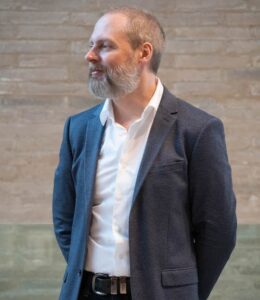
Photo Credit: Lili Autumn
And so etre-temps (2003) for piano, written for Harrison’s friend and former Huddersfield colleague Philip Thomas hampers our ability to sense duration by staging abrupt interruptions within long periods of silence; a leaf falls on loneliness (2007) for mezzo-soprano and four instruments confronts us with the contingency of memory by repeating a single bar of music (no more, no less) a total of twenty-seven times. At a still greater extreme, Vessels (2012–13), another work written for Thomas, contracts, expands and otherwise varies a single cycle of pitches for more than seventy-five minutes, simultaneously dilating and heightening our senses of anticipation, recollection, and orientation.
Loops are – ahem – a recurring feature. In surface forms (repeating) (2009) for ensemble, a forty-three-second loop is obscured first by its sheer length, and then by the music’s high degree of density and internal activity. Thomas once described listening to it as like trying to climb a rock face without having anything to grasp onto. There are more handholds in repetitions in extended time (2008) for ensemble, but Harrison disturbs us here by repeating each of the music’s five panels successively slower than the last, as though zooming in on a single passage of time – while still, of course, continuing the same eternal stream. We are made aware of the material reality of time, even as it seems to be distorting right in front of us.
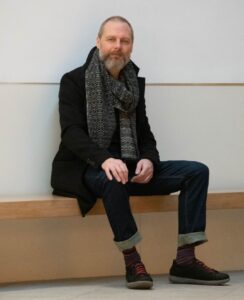
Photo Credit: Lili Autumn
More recently, Harrison has begun using technology to further question what it means to have ‘the same again’. In Dead Time (2019) for ensemble, he alternates digital loops with the ensemble’s playing to ask whether the precision of a digital copy affects our experience of time. Technology plays a still more interpretive role in Towards a slowing of the past (2023) for two pianos. Borrowing the metaphor of a reel-to-reel tape recorder, Harrison interpolates recordings of the two pianists, played in reverse and at slower speeds (and, accordingly, at deeper pitches). The effect of zooming in is similar to that in repetitions in extended time, but it takes place in multiple directions at once. Mark E. Smith’s saloon-bar inquiry has got a whole lot more complicated.
Profile by Tim Rutherford-Johnson
Tickets for Explore Ensemble’s performance of Bryn Harrison’s new work and full hcmf// 2025 programme now on sale here.