
Writing of Michael Finnissy’s First Political Agenda, the pianist Philip Thomas notes that ‘All Finnissy’s music is in a sense autobiographical’. There are few composers, in fact, of whom this is more true. Yet its truth lies in the unabashed – and hence universalising – honesty by which Finnissy writes himself as music: as wandering, obsessive, polyglot, passionate, messy and queer as any of us can be.
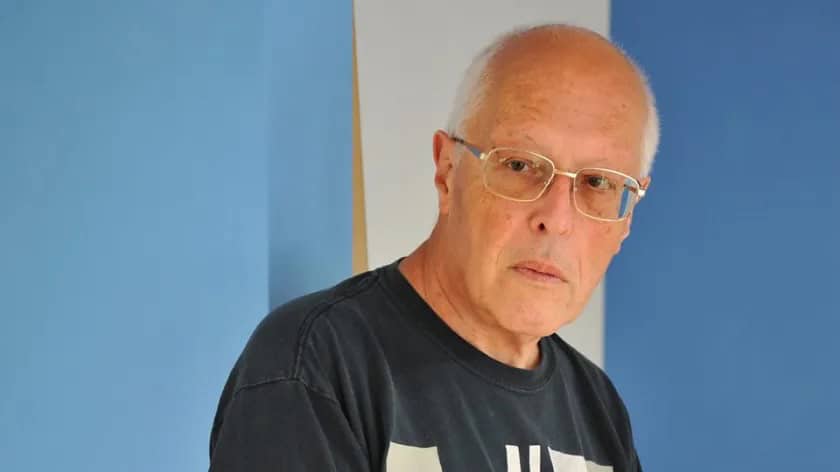
Finnissy wrote his first compositions aged four, and if, for most of the seven and a half decades since, he has been writing autobiography, he has equally been writing political agendas. Yet it was only in the mid-2000s that Finnissy began a series of pieces explicitly titled as such. (In fact, he began the First Political Agenda in 1989, but it was largely written in 2006.) Since then, he has written a total of ten – all for his own instrument, the piano – and it is fitting that hcmf// is celebrating his 80th birthday this year with performances of the most recent two, played by another pianist and composer, the Australian Rob Hao.
Like all of Finnissy’s prolific output, the Political Agendas cover wide ground, both thematically and stylistically. The First, an apparently personal reflection on Finnissy’s place as a composer, includes such movement titles as ‘Wrong place. Wrong time.’ and ‘Is there any future for new music?’ Its third movement, ‘You know what kind of sense Mrs Thatcher made’, remakes Hubert Parry’s ‘Jerusalem’ – a quintessential musical image of a kind of England Thatcher’s supporters may have desired – but renders it utterly devoid of meaning or excitement by playing it in reverse and with all the rhythms flattened to funereally slow minims: a musical analog for the effect Thatcher’s ‘sense’ had on the British cultural imagination.

Photo © Philip Adams
Meanwhile, the Second (2000–08) offers portraits of three composers – all outsiders to the musical canon – with whom Finnissy feels sympathy: Erik Satie, Arnold Schoenberg and Aleksandr Skryabin. If the political argument there is a little obscure, that of the Third is unmistakably targeted, written as it was in a few days after the Brexit referendum of 2016, and with movements titled ‘Corruption. Deceit. Ignorance. Intolerance.’, ‘Hier kommt U.K. Ichbezogen Populismus.’ and ‘My country has betrayed me’. The Fifth (2020) is a portrait of its dedicatee, the pianist Annie Li, her emigration from China to Canada and her encounter with contemporary music. And so on: in each one, the personal and the political are inseparable from the musical.
With the Ninth Political Agenda (2023–25), Finnissy turns his attention to one of his enduring interests: early American music, particularly those places where folk, European and religious traditions meet. Each of its three movements offers a take on the ballad ‘The Lone Pilgrim’, attributed variously to the Reverend John Ellis (1838) and one B.F. White (1850), and recorded in two famous versions by the Doc Watson family in 1963 for the Smithsonian’s Folkways series of American folk music, and by Bob Dylan on his 1993 album, World Gone Wrong. Meanwhile, the Tenth (2025–26) is a kind of three-part biography-in-music of Frédéric Chopin, one of the greatest of all pianist-composers, and a man whose music, in its evocations of a Polish grandeur being lost to the ravages of the Russian Empire, was inextricably linked to politics and the personal. In a set of brief notes on the piece, Finnissy brings it all back to the ironic self-critique of the First Political Agenda, completed twenty years previously: ‘The English do not regard Music as an Art, they think like builders – but bricklayers rather than architects’.
Profile by Tim Rutherford-Johnson