
It’s all about else. All the words that get used to describe composer Chaya Czernowin’s music are married to otherness: it goes beyond and reaches underneath, finding places submerged and digging into our subconscious. Her pieces are metaphors for the imaginary, putting us in positions and environments that would otherwise be impossible to conceive of. The sounds are visceral – using familiar instrumentation to create something abnormal, they frequently scan as feelings rather than as sounds. Even in her operas – which ask questions about human existence, identity and intimacy – she creates other-worldly breaks in space and time, enrapturing her characters and audiences in worlds with different rules.
Getting there has taken practice. In her university years, Czernowin studied with Yizhak Sadai, one of Israel’s most renowned composers. He got her counting every grain of detail: ‘Sadai asked me to analyse every pitch, every rhythm, every dynamic’, she told Daniela Shemer. From then on, Czernowin’s compositions have become more and more precise, carrying what she describes as ‘the concentration of a surgeon with a scalpel’. Her music has only become richer, and more visceral, for it; rather than get bogged down in the process, Czernowin delved so deep into the forensics of sound that she discovered the wildness underneath. Also contained in her work is the spirit of another one of her teachers, Abel Ehrlich, who encouraged her to think freely – to interrogate not only her work, but the boundaries of the world around her.
This approach informs 2013’s HIDDEN, one of Czernowin’s largest scale compositions. Written for strings and electronics, it explores a place ‘foreign and indecipherable’ to the human ear – somewhere that only Czernowin’s music could make present. I’ve mentioned the instrumentation, but it’s a disservice to think of the piece this way, to give you ordinary visions of an ensemble playing music. HIDDEN is foley art, its musicians creating visceral sounds that serve as analogy for something we’ve never known – for whatever it is that exists ‘underneath music’. Czernowin’s score suggests something physical is rooted within sound: the pitches are shrill, the string-work is coarse, and the percussion shifts like molten rock. Towards the end of the piece, the string players start groaning up and down their instruments in a destructive wave of glissandi, as if mimicking rotations of the earth’s core.

HIDDEN is indicative of Czernowin’s music. It is caught between pure imagination and zealous interrogation; it’s plucked from her head, but then intricately workshopped. ‘A title comes first’, she explains in an interview with Ensemble Musikfabrik’s Thomas Fichter, ‘and the name of the piece is like a seed that keeps growing underneath the earth’. The first part is simple – the rest of the world takes some building. The phrases she comes up with are suitably abstract – little turns of phrase with secret powers. On the Face of the Deep. Knights of the Strange. At the fringe of our gaze. Fast Darkness. Everything is just out of sight, on the periphery of manifesting. It’s there that Czernowin composes.
With HIDDEN, Czernowin began doing things differently. She was growing increasingly interested in how the flow of time was affecting her music, and came up with something she calls ‘infinite now’. This music, she argues, is outside the rules of standard time – there’s no path or progress. Rather than move forwards, Czernowin argues that ‘time is going inward’. With HIDDEN, her score burrows itself deep within certain music phrases, until there’s no movement or momentum – until we’re completely insulated from time. ‘Every musical phrase has a world inside it’, she said, talking to Classic Agenda. HIDDEN holds on to details that might be smaller, more cumulative in other pieces. In Czernowin’s hands, the scratch of a string might never stop resonating.
For a while, ‘infinite now’ became crucial in how Czernowin conceived of her work. She used the phrase to title her 2017 opera, an epic work spread over two and a half hours, drawing on Luk Perceval’s wartime play FRONT and combining its story with Homecoming, a dreamlike story by experimental novelist Can Xue. The slabs of overtone sound that fill up the opera cast a permanent state of stasis over proceedings, deliberately smudging the orchestra that plays alongside it. Czernowin used electronics to induce a never-ending slowness, something she has referred to as ‘dragging’. Honouring the sense of helplessness and entrapment that can be found in both Perceval’s and Xue’s texts, the piece feels separate from real time – another case of Czernowin going inside the moment, rather than moving alongside it.
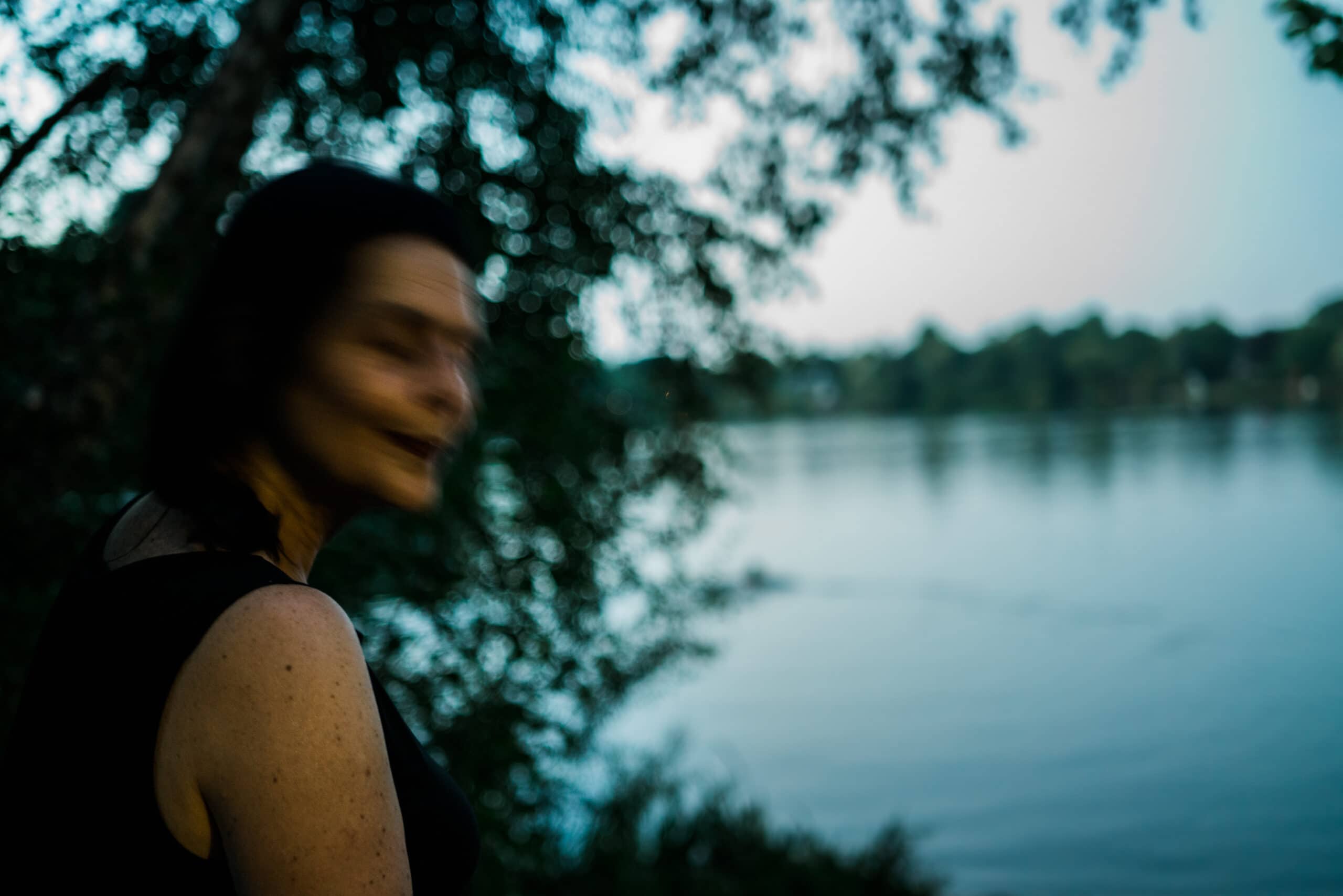
Czernowin is still looking for new ways to manipulate sense. Her 2019 work Heart Chamber is an operatic tragedy of her own making: the score uses an orchestra to create the timbre of a forest, generates vibrating surges of sound through the room, and amplifies the usually quiet whispers of ASMR. It is a meditation on intimacy, happening at maximum zoom: with two naked performers staged at the centre of the piece, Czernowin created something sensually overwhelming. Her pieces are never just immersive. You exist within them.
Scattered through our hcmf// 2021 programme, Czernowin’s music will come to life, expressed in every teeming detail by ensembles who have experienced the full breadth of her work. Ensemble Musikfabrik perform The Fabrication of Light, a piece that typifies Czernowin’s ambiguous, illusory approach. She compares its structure to optical illusions – ‘colours that seem striking and deep, but that aren’t really there’. Coupled with clarinet soloist Gareth Davis, the Riot Ensemble return to hcmf// with co-commission Fast Darkness, and the Arditti Quartet and IRCAM will also present HIDDEN, one of Czernowin’s most impactful compositions, combining string quartet, electronics and multi-speakers. This collection of work offers a pure distillation of her craft. It is music that sounds wholly its own, apropos of nothing.