
Our Artist of the Month for June, Nicholas Moroz has been developing his compositional language for years. In this post, he traces his music through three definitive pieces, from early experiments with guitars and electronics to his more recent collaborative works.
Semantron (2015/16)
electric guitar and live electronics
I think I see this as my ‘first piece’. Coincidentally, it’s also my first piece with live electronics. It helped that it was on my own instrument: electric guitar. Named after the metal or wooden plates struck like bells in eastern Medieterranean churches, Semantron hails back to my early teenage years, when I would spend hours experimenting with my much loved and now long-lost cheap multi-effects pedal. As a young guitar/bass player discovering music for myself I used to listen to older things like Jimi Hendrix, Led Zeppelin, Yes, and stuff that was happening at the time like Red Hot Chili Peppers, the Mars Volta, as well as lots of older funk, jazz, and r&b (Jaco Pastorious, Funkadelic). I think all the extended weird sections in a lot of the songs from these bands set me up for a wider interest in music beyond the guitar, and eventually composing.
Semantron is a piece about elastic loops, patterns, and melodies, which emerge from the harmonics of the spectrally re-tuned guitar. The electronics add a simple narrative structure to the otherwise circular guitar material. The electronics (just granulation and spatialisation with reverb) very slowly emerge and evolve, from a background haze into an all-enveloping blaze. At the time and still today I like creating a clear connection between instrument and electronics, like an extension or augmentation from reality to fantasy. In this sense I’ve stuck to live electronics because I find they offer a constructive constraint, plus I’m not very good at creating ‘tracks’ or working with DAWs; I get too distracted by all the possibilities with material and the sound production.
Intralatent (2019)
piano, percussion, and live electronics
My piece from hcmf// 2019 with GBSR Duo.
The title is a made up word, sort of sci-fi sounding, hinting at some of my interests from the time, so-called new materialist writers like Karen Barad and her notion of intra-action, and Jane Bennett and her idea of vibrant materialism. As part of my PhD I was interested in creating live electronics that somehow have a mind of their own (or at least to fake this impression for listeners! I’m not a computer scientist). So this piece is a kind of trio, with the human duo summoning a third nonhuman presence from the ether. It’s a piece of two halves or movements. The first is more structured and dynamic, flowing or cutting between slow and fast, loud and soft, again with this idea of elastic patterns (which again I probably owe to late Feldman and others like Grisey and Poppe), as well as in other things, like some electronic music (people like Mark Fell, Autechre, Demdike Stare, also, Flying Lotus, Thundercat, and Squarepusher).
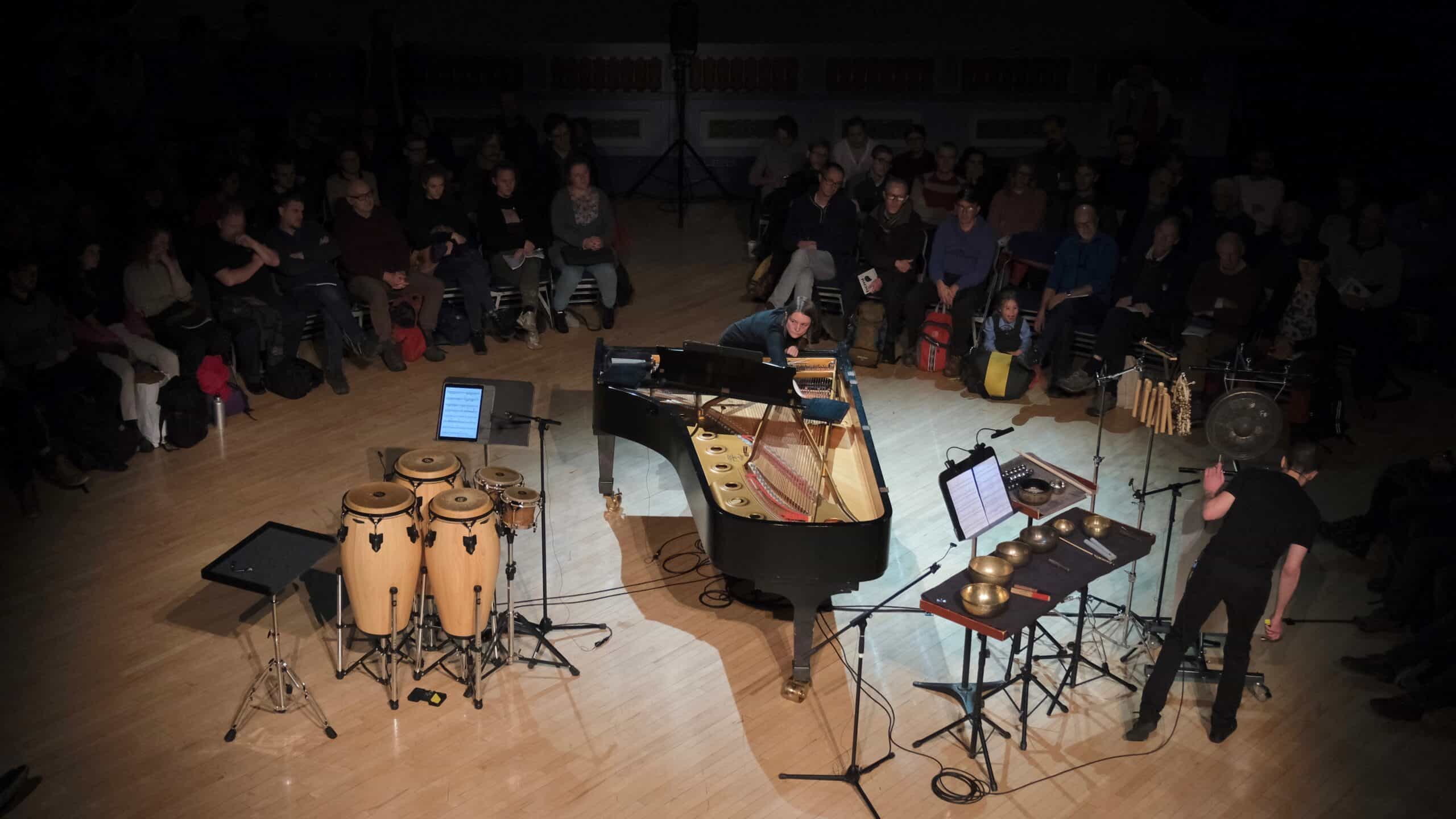
The second movement is more spacious and slow – perhaps a little similar to the end of Semantron. It’s dark and overpowering, like falling into a pixelated and iridescent abyss. I created this simple effect in Max, where a live sound is played back at half the speed and fed back on itself. This results in these ever sinking bell strikes, piano string groans, and rumbling sub-bass. Again the idea of elastic material is important – stretching the same rhythm, melody , or sound into new weird and contorted yet still somehow recognisable shapes. I often imagine music or even notation as a kind of warpable spacetime (I think it comes from Grisey). You can hear the effect clearly at the start of the second movement when George Barton, GBSR Duo’s percussionist, hits the singing bowl, but also in the bongo part of the first movement, which is basically just four hits constantly stretched into different rhythmic shapes. I spent a lot of time with George and Siwan experimenting with different sounds and electronic processes, they were very generous with their time and I had a lot of fun making weird noises. It wouldn’t be the piece it is without their dedication and inspiration.
Like Semantron, the piece is also written for a surround speaker set up. This reflects my interest in Luigi Nono, whose late electronic music I’m studying for my PhD. He often used spatialised electronics for particular venues and spaces to create a sense of fusion between acoustic and electronic sound. In Intralatent I wanted to give the sense of this ethereal presence of electronic sound as corrupted reflections of the live instruments, swarming around the audience.
The Holy Fool (2021)
trombone solo, female voices, harp, and string quartet
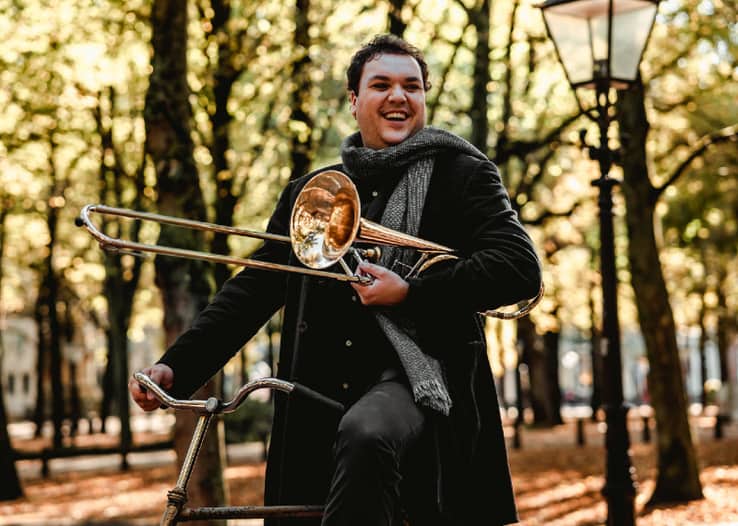
Photo: Sebastiaan Kemner by Fleur Bijleveld
Watch the premier of The Holy Fool via the video available here (Moroz’s piece begins at 16:25)
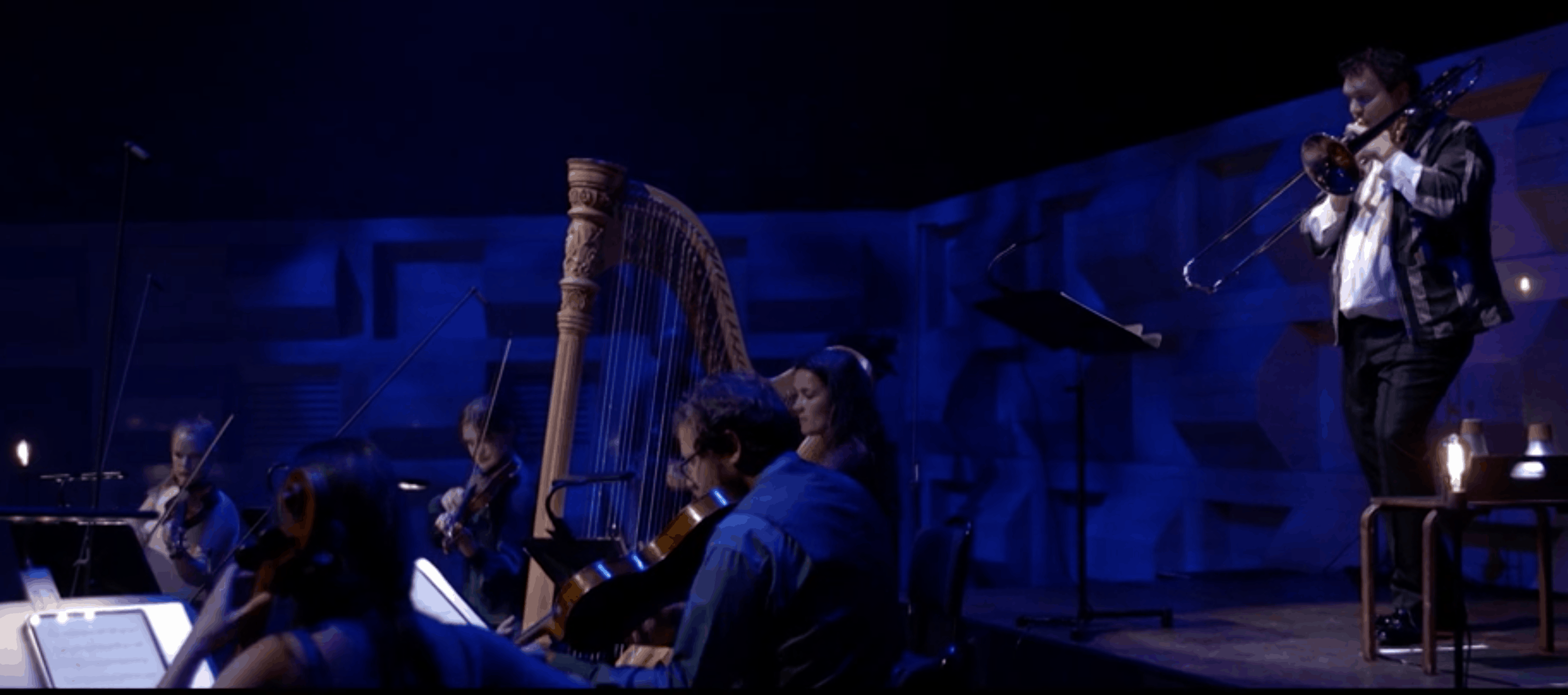
This is my most recent piece, performed earlier this month in Rotterdam by Silbersee, Lonelinoise, and trombonist Sebastiaan Kemner, who I met in Oxford, for his award concert after he won the 2020 Nederlandse Muziekprijs. I feel like it’s breaking some new ground, working with a different emotional palette, yet based on similar material to my earlier work. I had to compose it in a short space of time due to a difficult first half of 2021, so I decided to approach it intuitively, playing around with ideas, pretending to myself that I was just sketching until I had the bones of a piece. Fortunately it worked out!
As an occasional piece for Sebastiaan’s concert, I chose to explore two contrasting personas of the trombone which I found interesting: firstly the trombone as a clown or joker, and secondly as a funereal ritualist. I’d been watching a lot of Tarkovsky films and Shakespeare adaptations over the first lockdown, and they led me to the idea of the Holy Fool. I think one of the images I suggested to the musicians and singers in rehearsal was to imagine Sebastiaan as this cosmic pied-piper, leading the beguiling parade through ever stranger spaces.
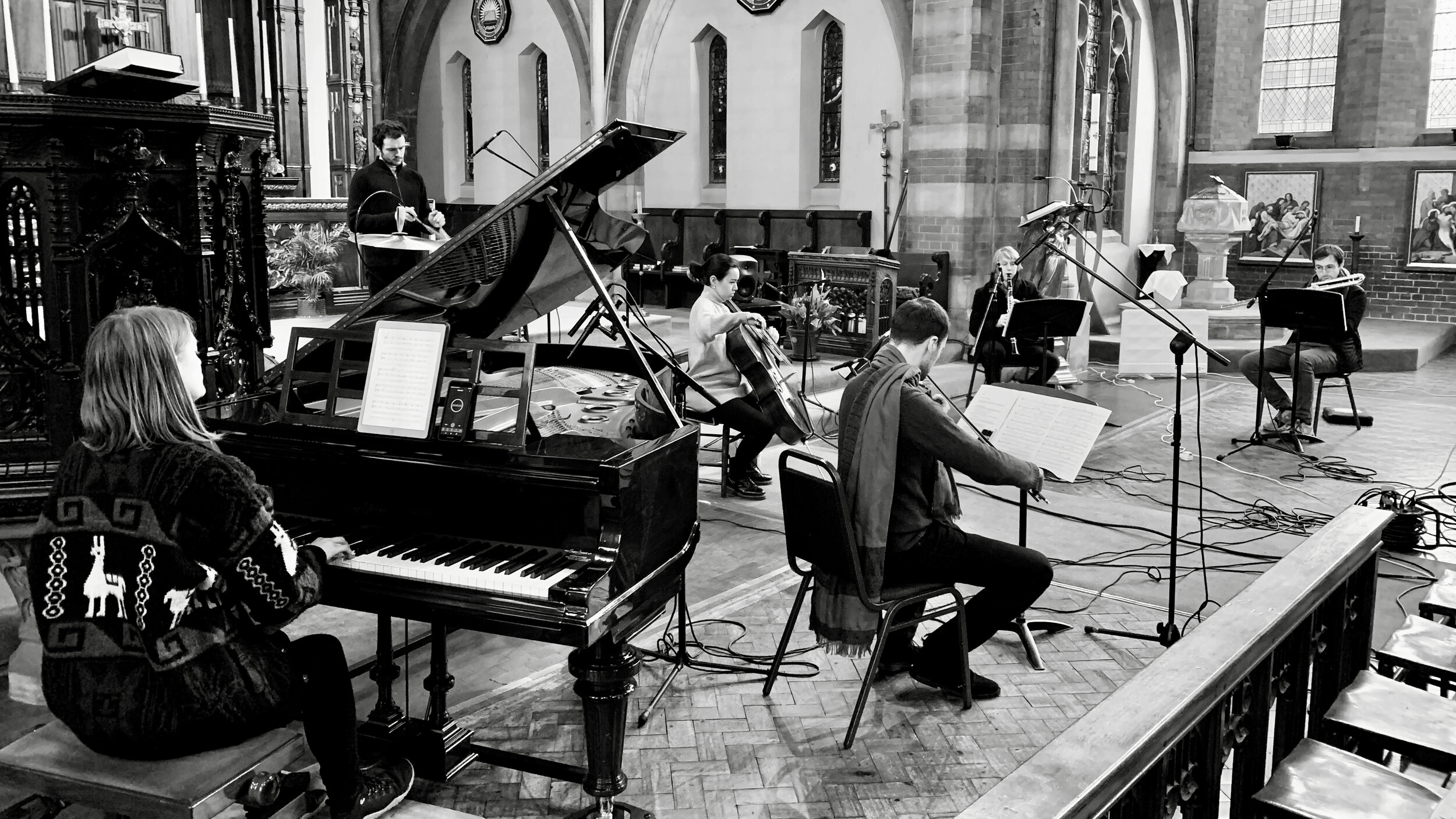
The Holy Fool also wouldn’t have turned out how it did without my work with Explore Ensemble over the pandemic. Getting up close and familiar with certain pieces and with the musicians’ sounds has made me better at imagining more or different sounds. I’m thinking of our Another Timbre recording sessions of Oliver Leith and James Weeks’ music, but also music by Lisa Illean, Cassandra Miller, and Klaus Lang, among many others.
In general I find the whole ‘imagining sound’ thing, or even frankly the idea of human imagination per se an overlooked topic these days, I guess partly because of the predominance of consumer technology and the subsequent homogenisation of musical norms.
What I’ve learnt from my teachers and from experiences with numerous musicians is that for me as a composer, the fun lies in trying to find a balance between control and freedom, or the known (expected) and the unknown. You can write a seemingly ‘perfect’ or at least ‘finished’ score but I’ve found that unless you leave room for surprises (good and bad), from the sounds themselves, but also from musicians’ suggestions, then it’s a straight jacket. Maybe it’s obvious to other composers, but I think there’s also a more general point that in making anything new I believe our practices should not be fixed routines or mechanised ‘workflows’ – I despise this word! Nonetheless, this is sadly how I think most orchestras and conservatoires work today. I hope it changes, but that’s another topic.
Over the first lockdown I was listening to a lot of Another Timbre’s releases – especially the discs with Angharad Davies, with her inspiring musicality, ranging from ghostly and serene, to animated and tactile. A lot of this listening led me to a new interest in improvisation, and the question of how to create continuums between fixed and free, formal and informal, written and verbal, and shared tacit knowledge. I’d like to explore these questions with my future work. I’m planning to write more music for electric guitar and electronics, incorporating more improvisation, and possibly getting back to some performing myself too.