
Recently, John Burton has been listening to birds. That sounds like a cliche, especially considering who we’re talking about: this is Leafcutter John, a sound artist known for creating music out of rurally-sourced field recordings. But it’s not like that; these sounds are just for him. Now on a daily routine of getting outside everyday for a walk, he’s been logging bird sounds on his phone, discovering new species as he goes. Since moving to Sheffield from London, new bits of nature have opened up to him, and this is one of them; ‘I have this app that helps you identify birds from their voice, and the app helps you know if you’ve heard a cool bird, one that’s worth stalking or not’. It’s a small, personal story that reflects the personal journeys we’ve all been going through in isolation. And it informs Lockdown Patchwork, a piece Burton has put together from over three hundred field recordings made by people around the country, all experiencing different kinds of travels in nature.
Lockdown Patchwork is a love letter not just to nature, but to our nature. With its huge range of contributions from across the country, it showcases the quite beautiful, often distorted and sometimes cursed landscapes of the United Kingdom. The piece goes into little spots disturbed by motorways and land ownership, and visits other spaces marred by inequality. There’s more than one type of greenery in the mix; using dozens of publicly submitted sound recordings, Burton’s piece visits backyards and awkwardly inserted city parks, while also trailing through public footpaths and sprawling hillsides. It visits allotments, where people such as Bella Gonshorovitz and Mariana Vodovosoff have found solace and escaped anxiety; it enters forests, places that suggest something more ominous, and unknowable, out there in the world, a feeling voiced by contributor Luke Turner.

Of course, it’s not nature that has these feelings; it’s us. All of this green space is transformed by our emotions, and our circumstances, and our politics. Burton started making Lockdown Patchwork out of sounds and sounds alone, but became interested in localising the piece, conducting interviews with the people making recordings. Through their words, his piece details the joy people find in the outdoors, as well as the challenges – and sometimes, the boundaries – that come with it. I came out of the piece feeling like nature was a far more complicated story to tell, and that it’s fundamentally different depending on who you are. There’s not just one green space, and Burton’s piece reflects that idea. It shows us how we live differently even in the simple act of going out for fresh air.
As nature changes hands, it changes timbre. It develops new layers. At one point in Burton’s piece, contributing field recorder Ian McMillan points out the buzz of cars coming from a major road that moves in parallel to his walking route. Once he tells you about it, it feels present in the mix, another crucial element of his local space. And there are different kinds of stories about nature and its obstructions: for some people, the pandemic has driven home how hard it is to access green space in the first place. Beatboxer and composer Jason Singh talks about feeling unwelcome, finding that ‘public land’ is just another thing determined by whiteness. There are also those for whom lockdown has been the first time they’ve had green space; at the very beginning of the piece, Zakiya McKenzie talks about her new garden, the first she’s had during springtime, and her experience of watching it grow.
Ultimately, Burton wanted Lockdown Patchwork to be a community piece, and that requires contrast. The piece emphasises the different kinds of relationships we have to nature, but also brings together these experiences as a constituency, counting all of us among the sounds that happen outside. A key part of this process was getting samples from the source: asking people to make field recordings is easy enough, but Burton wanted anyone to feel that they could, whether they had the equipment or not, and whether they felt they had anything to say about nature or not. For Burton, field recording is a way of noticing sounds for yourself, hearing bits of the ecosystem that you wouldn’t have before. It doesn’t matter if the recording is clear, or if people can even hear the same thing you heard when you recorded it. It’s just that you took a moment to listen.
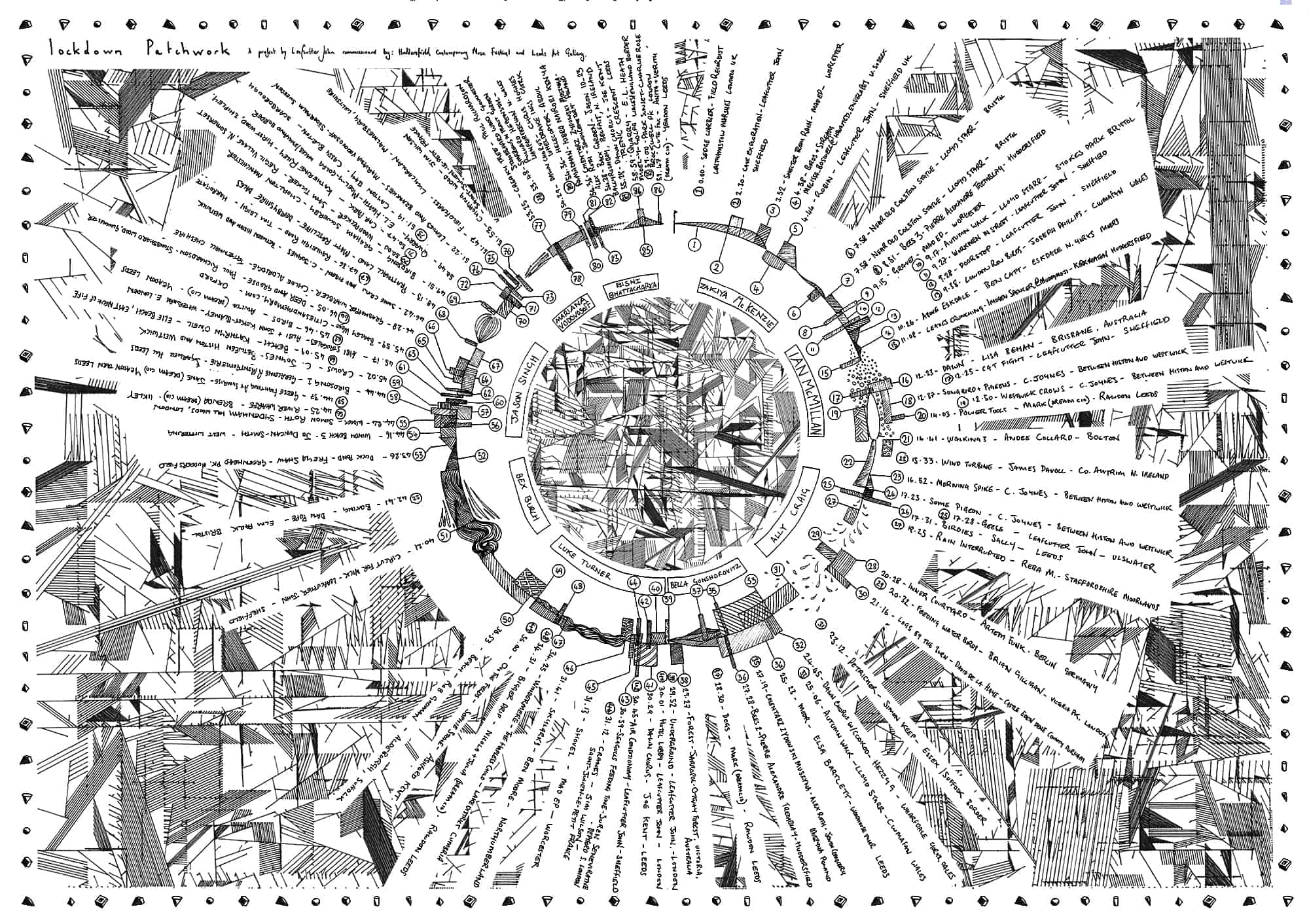
Burton has worked with field recordings for much of his career. His stuff is labelled folk as much as it is electronic, largely because it pairs pastoral sound with tech. On Yes! Come Parade With Us, he worked outwards from recordings he made along the Norfolk coastline, providing a mood music of rustic synth melodies and off-kilter rhythms with raw, unfiltered coast noises. On Lockdown Patchwork, the challenge has been different: these are other people’s recordings, and the landscapes mean different things to them. ‘It feels like a big responsibility – I’ve never worked with people’s voice before, and I need to make sure I’m not changing the meaning of what they’re saying to match my hidden bias’. One of the most wonderful things about Lockdown Patchwork is hearing the small moments Burton has chosen to accompany. In a moment of quiet happiness, he’ll offer a warm, metallic guitar chord. When there’s uncertainty, or doubt, he’ll forge forward with a motorik rhythm to nowhere.
There’s a well-worn charm to Lockdown Patchwork. Rather than create something pure in quality, Burton has given the piece a suitably lived-in sound, showing off his affection for rubbish musical equipment and shaky audio quality. He was wearied by the hi-tech crew he dubs ‘the posh field recording club’, a group who have effectively priced out newcomers with their preference for gear power and fidelity. He wanted Lockdown Patchwork to find some equilibrium in recording, placing submissions people made on ‘shit phones’ next to ones taken on wind-shielded dictaphones with fancy names. ‘If you send a sound, it goes in the piece, and it’s as simple as that – it’s the intention that’s important’.
Burton is attracted to the sounds field recording newbies have sent in – he likes the way the wind crashes against their tinny mics, obscuring the rest of the scene. It’s a mark of intimacy, the ritual of recording presiding over the actual results. ‘You don’t realise the extent to which your brain is focused on a sound and blocking out the other sounds, and when someone else listens back, they don’t have that same focus – that’s something you don’t get when you’re editorialising things’. These recordings are often more candid, too, offering just a bit more of the scene up: ‘When you get someone that hasn’t made field recordings much you get this stuff that is just really brilliant that you’d avoid if you’re more experienced. There’s a lot of what I termed interruptions, where toddlers just talk over the adult, which to me is joyous’.
Burton isn’t looking for his piece to be a solution to anyone’s lockdown problems. ‘It’s not a ten-step guide to feel better during the pandemic’, he says. And he’s right: instead of fixing to change how we interact with our great outdoors, Lockdown Patchwork acts as a kind of time capsule, documenting sounds and feelings from lockdown so that others can find themselves in the story. Right now, that kind of empathy is important: ‘‘In a way, my part of the music is just listening to what we’re saying. I hope it helps’.
Lockdown Patchwork will launch on Thursday 25 March at 7pm on Leafcutter John’s YouTube channel and the Leeds Art Gallery website.