
Kin_ (Cultura Plasmic INC) is blogging for us as our Artist of the Month for July. In her latest entry, she unfolds the themes of Watchtower, an audio-visual installation surveying the politics of security.
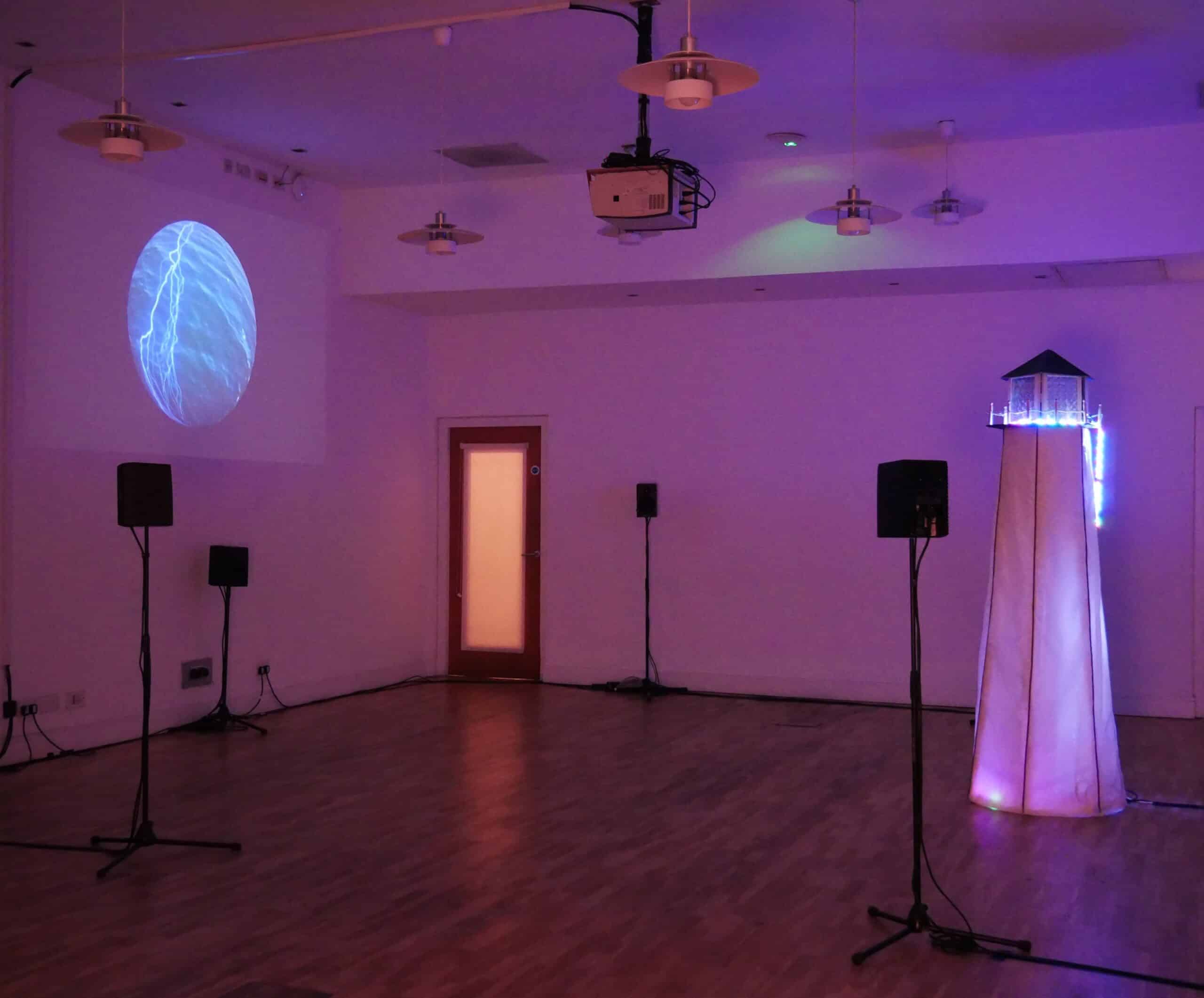
Watchtower is an audio-visual installation that I have developed and showed with Cryptic at the CCA Glasgow. Using surround sound, the structure of a lighthouse and footage from a drone to explore contemporary surveillance, the piece ends with a lullaby that I wrote called Blanket of Light. What I was particularly interested in was the weaponization of fear and the responding promises of safety and protection that are commonly used to justify surveillance techniques and infringements on privacy.
A lighthouse is designed to avert risk using its beam to increase visibility – and in the context of surveillance, visibility is presumed to necessarily lead to safety, overlooking important questions around who is visible to who and the power dynamics at play. I started thinking about the format of lullabies used to create a sense of security through sound. When looking at their use around the world, many encode messages of warning and fear in their subtext.
One example can be found in Japan, where working class teenage girls would sing Itsuki lullabies, relaying trauma whilst working as live-in carers for wealthier families. Another example from Japan is the Shimabara lullaby, encoding experiences of sex workers in South East Asia. One of the most commonly known lullabies in Europe and the US is Rock-a-bye Baby, its narrative telling the story of a child that falls to a devastating end in the face of environmental elements and tumultuous weather.
In Iceland, there is the lullaby Bíum Bíum Bambaló, which warns of outsiders lurking beyond the walls of the bedroom, and in Italy, one popular song experiments with fantasies of giving away the child in moments of parental distress and sleep deprivation. In Denmark, Mues Sang Få Hansemand expresses the emotions felt during economic hardship and financial difficulty.
But through the medium of a soft sing-song voice and simple, repetitive refrains, these messages are delivered in a way that is consistently lulling, hypnotic and re-assuring. To call upon a popular phrase, it’s not what you say but how you say it, and songs are so much more than their direct lyrical content.
At the moment, I am in the early stages of designing a sound installation incorporating the use of baby monitors to channel subversive lullabies that warns of the dangers of surveillance, encoding messages around the power of privacy, techniques to avoid tracking, and sidestepping the determinism of predictive technologies. I am in the process of writing five new lullabies that address these issues, and hope to publish them in a zine along with recordings, simple scores and texts about the collection of children’s data.