
Ahead of his performance at hcmf// 2021, we chatted to the saxophonist, improviser and composer John Butcher about his new piece, its collaborative nature, and the ‘psychological orchestration’ that lies at the heart of it. Book tickets for the concert here.
Just look at the contradiction of terms. Fluid Fixations is the title of saxophonist John Butcher’s new hcmf// commission, to be premiered at this year’s festival. Wryly, it suggests a situation of ever-spinning oxymorons, a space in which his ensemble of musicians might break out of determination, throwing away a set plan for the future in favour of their own. But where ‘fixed’ and ‘fluid’ might seem to present a conflict of interests, Butcher’s new piece presents them in a kind of harmony. His score positions these two musical qualities on a spectrum, making use of both. There are closed-off instructions, plain and uninterpretable, accompanied by prompts, and implications. ‘This is the delicate thing’, Butcher says, ‘If you pin things down too much, you can kill them. I want to give instructions that run from the very precise to the non-existent, in a way that allows the musicians to mould their playing into the piece’.
There’s a lot of subtext to Fluid Fixations – Butcher is writing the piece for thirteen other musicians, all of whom he has collaborated with throughout his career – mutuals who meet in a relentlessly overlapping venn diagram of the experimental music underground. ‘Ultimately, I’m the common denominator: the people within the group haven’t all played with each other, and there are some who won’t even have met before’. Through this lens, Butcher has created a situation where his knowledge of his colleagues, and the music they’re going to bring, is countered by the uncommon space he’s arranged them into.
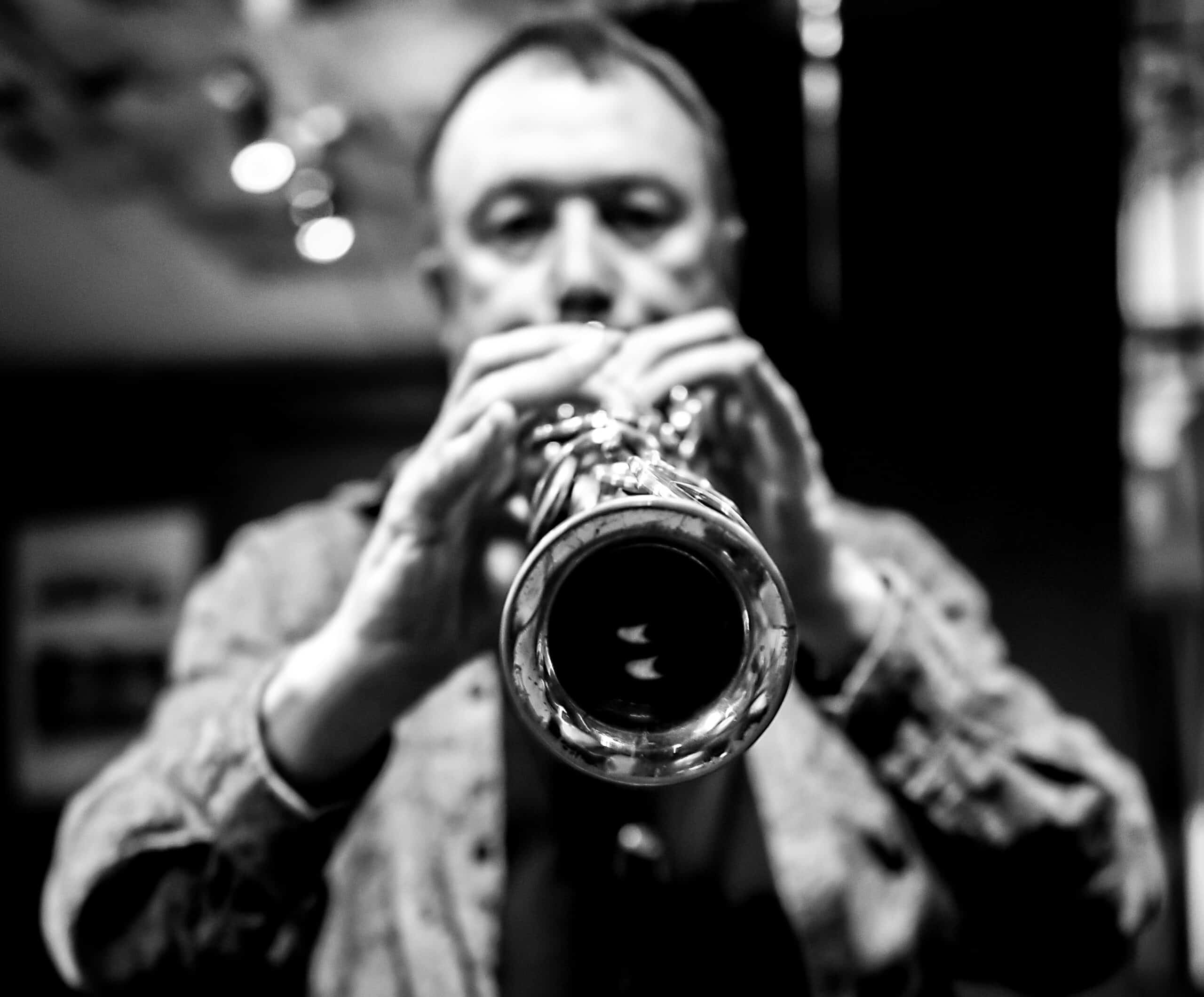
Though it might have the look of a big improvised ensemble, all hands on deck and do what you will, there’s considerable detail and direction hiding in Fluid Fixations. Butcher’s music has a kind of interiority to it, revealing the personalities of his performers, encouraging them to imprint themselves in the sound. ‘You’re not just getting a pianist’, says Butcher, by way of example: ‘You’re getting Sophie Agnel’. Through this deliberate head-hunting, his score evolves into something of a tailor-made playground, carrying ideas of how musicians might follow certain directives, and also how they might engage with the looser, more invitational moments of the score.
Fluid Fixations feeds into Butcher’s involved approach to composing. There’s not a linear course plotted from him, to a score, to the people who play it, but a simultaneous go of the three. ‘Part of what I’m engaged with is what I call psychological orchestration – if I take this combination of musicians, then I’ve got to imagine – like a conventional composer with notation – what it would sound like, what the decisions are likely to be, based on my knowledge of the people involved.’ At points in his score, Butcher has made use of photographs from his collection, all of different natural environments. These echo his faith in the transformative power environments have over music performance, but they’re also intended as prompts for moments in which his musicians step away from the score, playing freely and creating their ‘own world’ within the piece.
There’s two versions of Butcher at play in Fluid Fixations. As a composer, he’s emphasised by three of his own specially made saxophone recordings, placed within the body of the piece and manipulated live by turntablist dieb13 who has cut them to vinyl. ‘They are a way of adding my compositional voice to the piece through working directly with sonic material’. But Butcher is also one of the fourteen musicians on stage, a performer in his own right. He’s involved in the ritual of playing with, and adjusting to, the musicians around him, experiencing the music he’s written, within the new community that exists because of it – ‘if I wasn’t playing in the piece, I don’t think I’d be interested in doing it.’