
Helen Anahita Wilson always knew she would be a musician. Developing a deep fascination with the piano in her early years growing up in Worcestershire, the now-Brighton based artist couldn’t conceive of being anything else. Yet her professional descriptors – award-winning composer, sound artist, researcher, improviser, pianist – reveal an extensive career that has undergone several transformations, each new turn responding to life experiences and reflecting her ability to take change in stride.
As a composer of contemporary music, she harnesses both Western and South Asian training, and her background includes an education in classical too. Radio art and acoustic ecology feature prominently in her practice. She earned her PhD in Music and Health Humanities from SOAS, researching corporeal acoustemology (‘a sonic and auditory knowledge of the body, health, and illness’). Additionally, she performs in a duo with tabla player Shahbaz Hussain and as a solo improviser.
Before these artistic developments, Helen’s earliest creative memories pair a young, eager curiosity with a supportive family. “I remember my dad collecting loyalty stamps from a petrol station down the road,” Helen shares, recalling life as a three-year-old. “He gathered enough stamps to get a tiny electronic keyboard with a little songbook. He brought it home and I learned all of those tunes instantly in one evening.”
This would lead to the acquisition of a second-hand piano from her grandparents’ antique shop, on which she’d take her grandfather’s requests playing back melodies from tunes on the radio. Then the piano lessons began. “I decided there and then that I was going to be a musician. I’ve never considered doing anything else, except for when I was 10 and I liked the idea of being a stockbroker for a few weeks. Seeing the video of the trading floor in New York with all of those people doing hand signals… I loved the shape of the hands and the way people were communicating with their hands, which feels in some way connected to being a pianist.”
Helen’s current modes of communication are similarly precise. “I’ve often felt that the music I make with all my different hats on tends to be kind of niche. I get extremely interested in certain ideas, fields and techniques, and tend to go deep in those areas.” Her approach embraces a focus on her practice and process rather than on any ‘final product’ or an audience. The fruits of this freedom often come to light during the juxtaposition of collaborative performance.
“I really enjoy the intensity of duo performance, having a spacious but passionate dialogue. It tens to involve quite a lot of improvisation, yielding to what is happening at that moment in that space, and of course you’re bringing all your habits, practices and learnings.” Helen describes the South Asian classical music concept of jugalbandi, a form of duet that translates as ‘conjoined twins’. “In order for something to be a true jugalbandi, the two components have to be quite separate: different musical backgrounds coming together with different sounds and approaches. That contrast and that desire to create something unique, melding and bonding styles is really exciting, particularly if both people are willing to really experiment and properly throw ideas back and forth.”
Helen’s piano-and-tabla duo collaborations with Shahbaz Hussain gesture towards this dynamic. The pair have been working together for around half a decade, and as they look to release their third album later this year, their partnership is as rich and inventive as ever. “It’s contrast but with understanding and respect. I would need about four lifetimes to have anything near Shahbaz Hussain’s understanding, but I do at least have some years of training in South Asian rhythm, so I can understand the patterns that he creates and the mind-boggling subdivisions and phrases he can throw out. That helps bring about something that’s cohesive and isn’t a conflict – it’s a meeting, a contrasting meeting.”
Thinking back to her frustrations with music school, where the focus on classical proved wholly unappealing, Helen recalls a crucial introduction to contemporary in the form of Steve Reich’s Drumming. “I used to listen to that album every night for years. There was something those patterns and listening to the cycles and phases coming back round together that was so fascinating and reassuring at the same time.” Through its cyclical resolutions, it shares a resemblance to the South Asian musical systems she would later become so drawn towards.
“I got the flu 10 or 12 years ago, and I was just lying on the sofa, feeling sorry for myself. I flicked Sky Arts on and they were showing Darbar Festival. There was a concert with a khayal singer called Manjusha Kulkarni-Patil, and I was blown away. I had never heard anything more exquisite, intricate or sublime.” This marked the start of a new passion for Helen, which she pursued all the way to India. “I found myself in Udaipur, Rajasthan, at Jagdish Temple, listening to bhajans and the most incredible, devotional, joyful music I’d ever come across.”
On her return to the UK, Helen headed straight to SOAS to sign up for a master’s degree in South Asian classical music. During this time she analysed vocal styles such as dhrupad, learned to play the santur, and spent many hours listening to music in the gurdwara. The more she studied this music, the more she realised she had left to learn. This led her to a PhD researching classical music festivals in Kerala – namely Swathi Sangeethotsavam, a 10-day celebration of 19th century composer-king Maharaja Swathi Thirunal which Carnatic musicians all across southern India fly in to give concert at. “This was my research subject, looking into the archives and history, but also analysing the festival through practice-based research and looking at hierarchies of percussion, rhythm-playing and composing in the traditional Carnatic instrumental set-up. I had booked another flight to Mumbai in December 2019 to go for months and months, to do all of my research, but then the day before, I was diagnosed with a super aggressive form of breast cancer which meant I had to stop everything and then COVID hit a few weeks after that.”
This diagnosis wasn’t the first time Helen had adapted to a health condition in order to create music. She’d spent the early years of adulthood playing incredibly demanding contemporary music, and when a health crisis arrived in her 20s and rendered her hands unable to stretch to such enormous chords, she had to rethink her repertoire. “I found this teacher who was quite a maverick and a bit of a legend, Peter Feuchtwanger. He taught Martha Argerich and a host of brilliant pianists. He went to SOAS in the ‘60s and studied South Asian and Iranian music, developing extraordinary styles of paying which were fluid and kept the hands in a very natural, relaxed and ergonomic state. I studied with him for a while and he taught me all sorts of techniques and the beginnings of South Asian and Middle Eastern music.”
These experiences with illness would ultimately prove to be liberating, in no small part due to Helen’s determination to find a silver lining. She had seen these junctures as an opportunity to turn away from learning and playing music she didn’t enjoy and instead turn to playing that which was physically pleasurable. “I became much more rooted in my body and the craft of sound-making, using my hands in the best possible ways to create sounds that were satisfying and meaningful to me.” Musically speaking, this meant a move away from harmonic manipulation and towards the rhythms and melodies orbiting central drones in South Asian music.
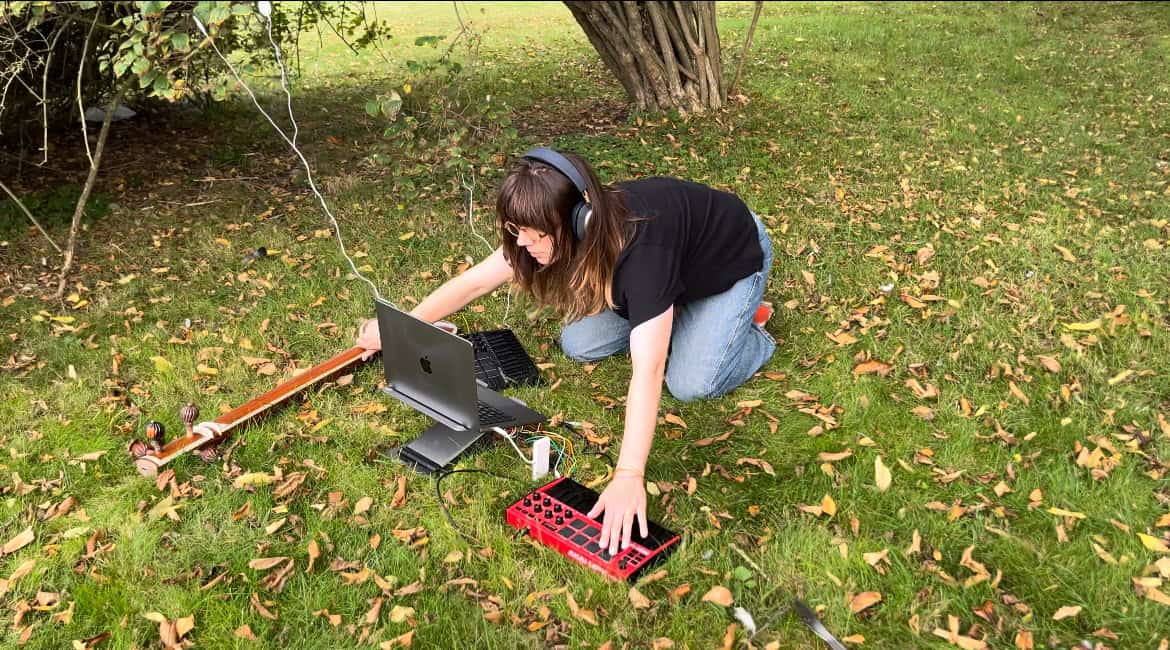
When Helen was diagnosed with cancer, it would take a massive toll on her body. An intense, challenging couple of years filled with chemotherapy, surgery, radiotherapy and immunotherapy kept her in the hospital much of the time. Chemotherapy in particular was terrifying, given how toxic and poisonous plants for drugs in the treatment are. “But when I learned lots of the drugs come from common plants found in my garden growing up,” she recalls, “I found that incredibly reassuring.” This would lead her to visiting London’s Chelsea Physic Garden, where an oncology section houses all sorts of plants with anti-cancer properties. She began measuring bioelectric fluctuations in the plants and applying contact mics to trees, identifying their signatures and working with them in parallel to how phrases are characterised in ragas.
“I was thinking about creating music with toxic plants used to treat cancer. The hospital is a really sterile environment, very plastic, metallic and reflective, where sound is bouncing around the place. It can be quite an intense auditory environment.” Released last November, linea naturalis (we are all bioelectrical beings), was Helen’s attempt to connect people in hospitals back to nature, to make the experience of treatment that much easier. “People are listening all over the world. I got a nice message from a Zen monk in California who’d been looking after the monastery garden for 30 years and was diagnosed with a brain tumour. He was given this piece of music to listen to in hospital while he receives treatment, and he tells me it connects him back to this garden where he’s spent so much of his life.”
hcmf// audiences were introduced to Helen through KRANKENHAUSFUNK and the extrinsic death receptor pathway in 2022, debuted as part of the shorts programme. The composition is both inspired by and an attempt to come to terms with her own treatment, retooling chemotherapy machines to reflect patient experiences for a reimagined hospital radio. “I wanted to regain some control, because cancer treatment is not a fight. It’s about trusting teams of strangers who do absolutely awful things to your body with the very best of intentions. My body was improvising the entire time, just trying to cope with what was going on.” This was an opportunity for Helen to creatively experiment with machines she had previously found frightening, and lent itself to her interest in ‘sonic life writing’: telling biographical stories through non-lexical music and sound.
“Our cancer vernacular is really very poor, especially in English. Like Susan Sontag said, the best way to be ill is to be honest or truthful. Most of the ways we talk about cancer or share stories about illness is misleading, we use silly metaphors that aren’t appropriate,” Helen points out, referring to warfare-related concepts such as ‘battling’ or ‘fighting’. “My interest is how you share an honest account of an experience through sound. You can articulate very complex, difficult and sensitive emotions through rhythm – it’s effective as a way of sounding out one’s feelings or examining relationships.”
Citing Brandon LaBelle’s framework of acoustic justice, listening as a form of care and the need for this in Western healthcare systems, Helen recognises the piece as her first foray into storytelling and giving testimony. “It’s been stimulating, allowing me to think about the social purpose of a piece and I’ve still got a long way to go. All the pieces I’d describe as works of sonic life writing that I’ve written so far have used my experience as an autoethnographic subject, so now I’m trying to not think about me.” Her current project looks to generate compositional methods from the scientific methods of chemist Dorothy Hodgkin, Britain’s only woman Nobel prizewinner in the field. “I’ve got quite a lot of enthusiasm to push this forward, and see how many lives I can sound out truthfully through music and rhythm.”
Interview by Tayyab Amin