
When writing Anthem, the celebrated song from his 1992 album The Future, Leonard Cohen certainly wasn’t picturing Sarah Hennies visiting charity shops (aka thrift stores). Yet one couplet is unintentionally resonant: ‘Ring the bells that still can ring / Forget your perfect offering.’
For several years now the composer and percussionist has been building a large collection of cheap – the rule is less than $5 – bells from such shops. Enticed by the flawed chimes and off-kilter harmonics of what many musicians might dismiss as unwanted trinkets, she has worked her finds into several of her compositions. But in Hennies’ hands, even more customary vibraphone, drums and strings can be just as surprising and unruly: as she wrote for the sound art website Lateral Addition in 2017, ‘any object is potentially fascinating if you just play it the right way.’
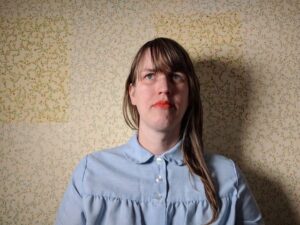
Photo credit: Mara Baldwin
Now living in Ithaca, New York, Hennies was born in Louisville, Kentucky in 1979 and by her early teens was already drumming with a group of older musicians. In late-80s and early-90s Louisville, enthusiastic kids twisting hardcore music into experimental new shapes had a lasting impact much larger than their contemporary success. While her band The Telephone Man never matched the influence of Slint, Rachel’s, Squirrel Bait’s David Grubbs or Drew Daniel (later of Matmos), it’s tempting to see connections between the group’s melodically austere post-rock palettes and entwining math-rock arrangements and Hennies’ later direction.
Moving to Illinois to study percussion, she found Herbert Brün’s experimental composition classes formative in expanding her concept of what a composer could be. It was while living in Austin, Texas and drumming with indie-folk group The Weird Weeds that she composed her breakthrough work Psalms (2009), three solos for vibraphone, snare drum and woodblock, whose unflinchingly spare minimalist pulses opened up rich worlds of tonal complexity.
Subsequent works such as the vibraphone duos Settle (2012) and Flourish (2013) dug deeper, engaging with both the tactile qualities of each instrument and intangible webs of harmonic overtones, subtle shifts in the balance between musicians creating dramatic changes of perspective. Several works around this time also harnessed the power of specific spaces, such as the percussion quartet Embedded Environments (2016), recorded in a highly resonant silo, or the vibraphone solo Sisters, gently shimmering pulses written for the interior of a centuries-old church in Slovakia.
Hennies composes more by intuition than through systems, and while continuing to find beauty and unease in psychoacoustic effects, her work from the past decade emphasises human listeners over frequency calculations. Likewise, the focus of repetition is on how it elicits change in audiences, whose reactions evolve with each iteration. In the cello-percussion duo The Reinvention of Romance (2018) repeated phrases provide a metaphor for the daily rhythms of a long relationship, moments of friction ceding to a cumulative sense of intimacy and security.
Hennies also highlights the humanity of her performing musicians through the demands that such pieces make of them. The inevitability of failure can be a source of humour, such as Kisses (2020), a Prince-inspired piece written for percussionist Andy Myerson that challenged him to maintain four simultaneous yet unstable tempos while also throwing items into a metal bucket.
Conversely, Falsetto (2016), a 30-minute endurance feat whose soloist must keep increasing handfuls of those junk-shop bells tinkling, without missing beats on bass drum, maracas and woodblock, draws more sobering parallels with the difficulties transgender women face when modulating their voices to sound acceptably ‘feminine’. Inspired by Hennies’ own experiences with vocal exercises when she transitioned, such gendered expectations around voices are further questioned by the prepared piano solo SOVT (2017) and the multimedia work Contralto (2017), where documentary video of trans women working through the exercises and sharing their thoughts is accompanied by a soundtrack of vocal humming, sine waves, strings and percussion.
With her string quartet Borrowed Light (2023) – receiving its UK premiere at hcmf// – Hennies revisits the flawed pursuit of perfection through the lens of America’s Shakers. Although sharing the democratic Quaker concept of a holy ‘inner light’ in everyone, the faith community’s utopian standards (and veneration of celibacy) have led to their near-extinction. Framed by delicate harmonics, the piece’s silences evoke both spiritual quest and growing isolation. To complete Cohen’s verse about the bells: ‘There is a crack, a crack in everything / That’s how the light gets in.’
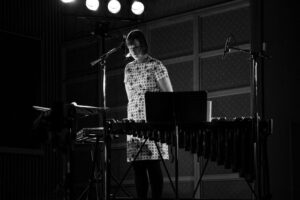
Photo credit: Claire Harvie
If pushing musicians to the point of overload reminds us that they aren’t machines, Hennies’ 2023 work Motor Tapes – another UK premiere – explores the ways that we might be after all. She wrote it for Ensemble Dedalus after being intrigued by neuroscientist Rodolfo Llinás’s theory of brain activity being analogous to a mass of tape loops: patterns that when played back fire thoughts or movements. If the simplicity of her early pieces suggested single sparking neurons, this 60-minute tapestry of overlapping pulses, convulsive snares, exhaling strings and brass, nagging earworm motifs, and bursts of agitation followed by periods of calm, suggests the ungraspable subconscious of a full human mind: repetition as the building blocks of every individual.
Profile by Abi Bliss