
Maybe you can tell, ahead of time, what kind of music Cath Roberts’ band Sloth Racket plays. Maybe you can hear something upstairs, when you read the name – a lazy, joyful noise that’s sort of exploding and tailing off at the same time. Maybe you can already imagine them live, meandering about in a discordant chain of guitar, sax and drums. If not, I’ve just described them to you. Formed in 2015 by Roberts and a supergroup of UK-based improvisers, Sloth Racket has been the principle outlet for the baritone saxophonist ever since, her personal space for writing music, improvising ideas and performing live. The band’s records are all about tinkering and trying; they capture the synchronised minds of five familiar collaborators, going up against the discombobulated unknown.
On some level, Roberts is composing, writing music that Sloth Racket play together. But the words ‘on some level’ are doing a fair bit of work there; she and her bandmates tend to be working off scraps, improvising around tiny ideas. The group are very into the idea of riffs, and Roberts tends to write aphorisms inspired by heavier, more guitar-oriented music that they can freefall from. These short burst moments sound like the metal version of jazz heads: the title track from Dismantle Yourself opens with a sluggish guitar lick, almost Sabbath-like in its worship of lethargy. The group plays around with it, sloshing the idea back and forth and getting used to the feel of it – before taking the whole thing off course, into free roam.
For Roberts, writing elements of music for Sloth Racket is a non-linear task. Tunes don’t have to follow the set path of songwriting into improvisation. That’s a useful jazz trick, but it can be negotiated; some of her writing shows up later on, amongst the chaos, dropped in as a moment of musical espionage. Butterfly Takes the Train seems to find some form of assembly at the nine-minute mark, locking into a piece of saxophone interplay that gorgeously sounds like two people finishing each other’s sentences. On Octopus, the group join up for a lamenting mantra, having departed from the tune’s wayward opening of puckered mouthpiece noises and octave jumping. The band make these random, improvised openings just as intriguing, as if an idea is half imagined, the rest yet to come.
This is all speculative, of course, because it’s hard to know where writing comes into it with this band, to distinguish between a moment of musical cohesion and something that’s been hooked up by telekinesis. Sloth Racket is assembled from an enduring collaborative family of musicians, all of whom have played with each other in some different iteration of the band you’re hearing. You could draw up a Venn diagram if you wanted to lose your mind a bit. Roberts does things with guitarist Anton Hunter in Ripsaw Catfish, a sparse, shoe-shuffling experimental outfit who’ve been going since 2013. Hunter, by the way, is the brother of drummer Johnny – they play in the Anton Hunter Trio with bassist Seth Bennett, and seem to hack jazz, doing game-breaking through noise and post-rock. On top of that, Roberts has a tape coming out with Sam Andreae, the band’s alto saxophonist, and the entire group plays in Article XI, where things get gloriously rowdy.
Roberts made things easier for me by showing me some of the scores she wrote for Sloth Racket songs. They’re hybrids, graphic scores containing little nuggets of notation, wrapped up in speech bubbles and flow charts. There are some wonderful flourishes to be found in them, with four bars of written music for one instrument accompanied with little zig-zagging squiggles and an exasperated scribble of ‘improv!’ for others. One score, for Animal Uprising, contains a circle with musical figures that orbit it in squares. It has another diagram, with two boxes, one reading ‘duo’, and a bigger one that says ‘trio’. Some of these scores have band member names on them, which feel like inscriptions: these are the kind of instructions that belong to, and can be understood by, a very small group of people, like code with clefs.
Throughout all the projects, Roberts is keen to point out the practice of DIY that keeps everything turning. She puts out all of her music on Luminous, a label she co-runs with Dee Byrne; the duo also promotes gigs as Lume. All of her projects have been scenic-route endeavours. There’s been a lot of graft and a fair bit of problem-solving: Sloth Racket is problematic to record, due to the acoustics of their set-up, so they’ve found themselves putting bassist Sam Bennett in his own booth during album-making. Worth it, though.
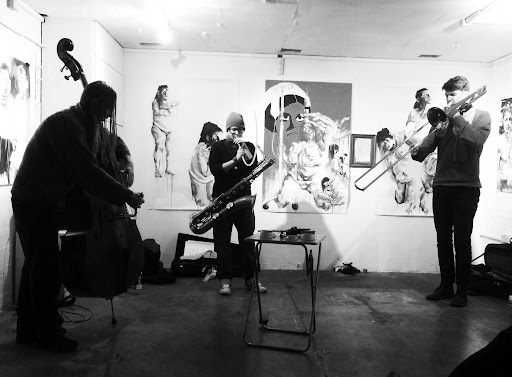
Roberts’ new project is off the grid, away from her usual collaborators, comprising a trio with trombonist Tullis Rennie and double bassist Otto Willberg. The group formed in 2018 and have been wilfully disruptive ever since. They’re downright belligerent, albeit unto themselves; all of their improvisation is done through response to objects they find and ‘respond’ to musically, much of it intended to interrupt them and push them off whatever expected course is laid out ahead of them. Roberts talks at length about ‘the table’, a setting on which they place all of these objects in their rehearsals. It was initially a framing device for a long concert they wanted to give some structure to; they now come back to it every set, filling it with trinkets. When I talk to her, Roberts flashes back to a time when Rennie put a small toy reindeer on the table, remembering it as if it were a disturbance in the fabric of the universe.
The project is silly, Roberts says. The core focus is the music, but the route is paved with daftness. The table has proved a catalyst for elements of performance art, with the group often just chucking things around the room. Willberg once tried miming, too. It all seems a bit cabin fever, from the outside, a cult of three whispering ‘the table!’ at audiences who haven’t been indoctrinated. The energy is unique, though, and so is the result– the group stumbles into new arrangements of sound, sourced directly from the surprises laid out in front of it.
Roberts’ new hcmf// commission was written with the members of the group, and their hijinks, in mind. It places them in a familiar line-up, circling an uncooperative thing. This time, it’s one of Roberts’ suggestive scores. She painted the composition’s outline onto a large cardboard cut-out, and broke it into tiny, indecipherable fragments, leaving the remnants open to what little interpretation can be had. It’s a way of owning a bit of the distorted reality the last two years has put artists through – embrace the fragments, Roberts’ piece says, and call them your own. A pocket-sized moment is all you need.