
Ahead of Brigitta Muntendorf and Michael Höppner bringing their installation Memorial of Rebellion to hcmf//, we’re revisiting our feature on the project, initially published in early 2020! Book tickets for the exhibition here.
Brigitta Muntendorf’s new installation, Memorial of Rebellion, is about protest songs. How have protest songs been lately? Are they good? In 2016, singer-songwriter Amanda Palmer described the inauguration of Donald Trump as ‘our moment’. He was ‘going to make punk rock great again’, ushering in an era of songs about his fascism. It’s a well-worn theory: the worst times will produce the best art. And it’s dodgy, in the main, because it positions protest as a prize, something we luxuriate on. But we’re in a strange time: the mainstream is different now, curiously politicised, and so it’s worth thinking about: have protest songs become a commodity? In Memorial of Rebellion, Muntendorf considers the genre on these terms, exploring the strengths and fragilities political songs are born from. She considers how protest music has evolved, to what communities it’s belonged, and how it’s even ended up in the behemoth of pop music, travelling for free on industry power.
Memorial of Rebellion meditates on where exactly we find protest music now. No longer folk music, not just a punk thing, it has entered into the mainstream. It’s been seen in Dave’s “Black”, in Kendrick Lamar’s anthem “Alright”. Your mileage may vary, but you could label something as pop machine as the 1975’s “Love It If We Made It”, an oh-yes-we-did call back to “We Didn’t Start the Fire”, protest music. Action exists not only in pop music, but the mobilisation of it, whether in the BDS movement, or the Bernie-fication of indie rock. With popular culture having lived online for years, mingling with an increasingly accessible underground, artists are willing to join up with the fringes.
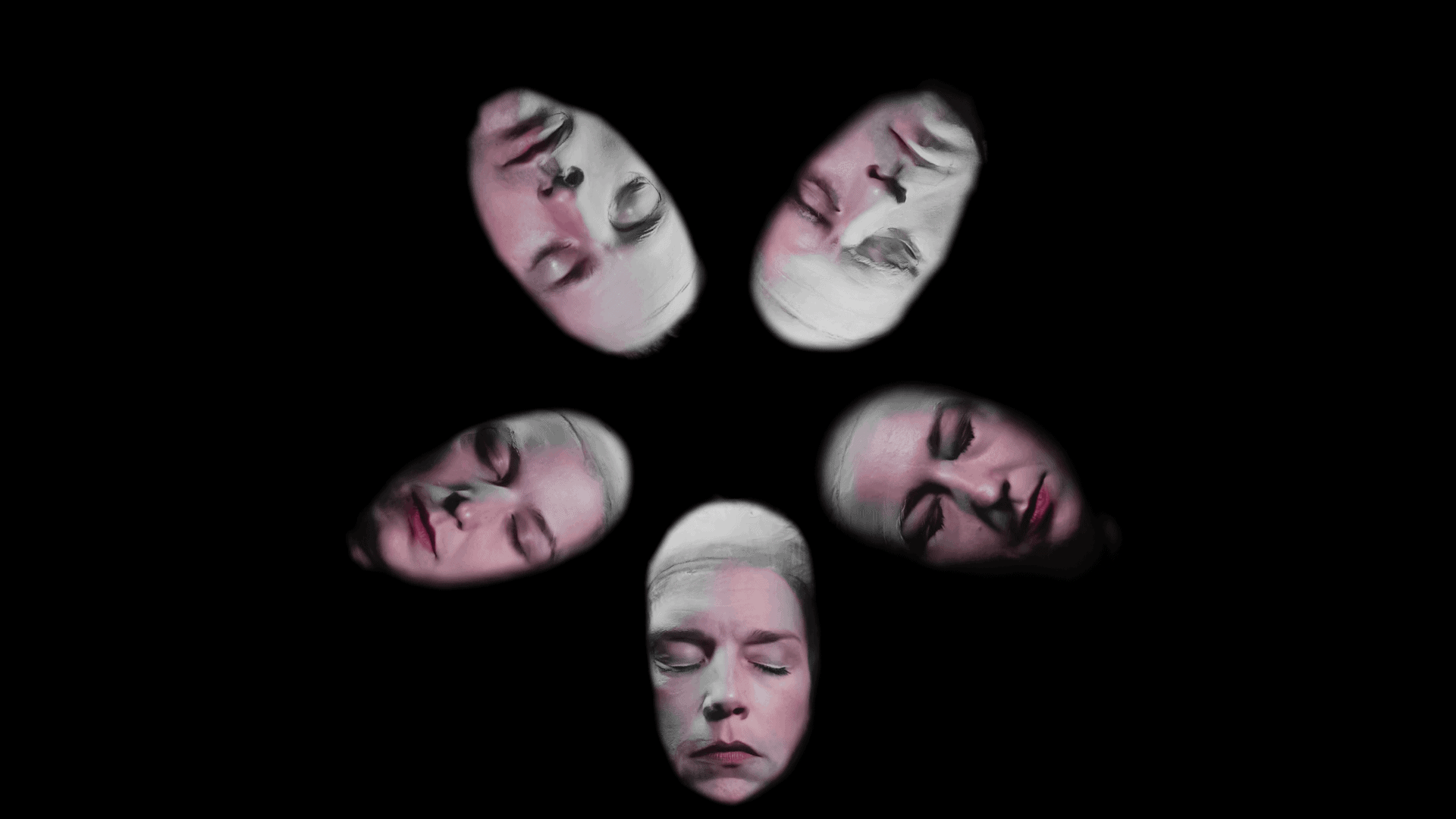
It’s not new, popular protest music. But Muntendorf is fascinated by our generation’s version of it, interested in how musical uprising conflicts with a capitalist industry model. She’s noticed a smoother protest song, one that sounds like something a lot of people would listen to. She calls it ‘contradictory, resisting and affirmative’, considering different flips of the same coin: ‘uproar’, yes, but also ‘party’, explosive songs of righteous celebration. The contradiction is built into it; how can pop music be truly uncomfortable? A famous protest song in this world fluctuates, says Muntendorf, moving ‘between riot and conformity, [appearing] as immortal as it is vulnerable at the same time.’ Songs of Rebellion, the multimedia work for a small group of performers that she has created together with Michael Höppner, is a surreal inversion of those things, choreographed so that the performers appear like a community, or even a cult, of the music they’re playing. Throughout the piece, they make bizarre, indecipherable gestures, floating aimlessly through a torrent of stray noises.
In its original form, Muntendorf and Höppner had actually created a concert piece. Known, back then, as Songs of Rebellion, their collaboration consisted of performers working their way through a hyper referential piece of music which includes thrown off homages to well-known moments in musical history. Amidst the shards of discordant string work, oscillating electronics and instrumental hiccups, were iconic mantras: in the piece’s trailer, “this is a man’s world” comes blaring through, sung with the gusto of the James Brown original, but attached to the worst, most inattentive backing band possible. Memorial of Rebellion was salvaged from Songs in the wake of the pandemic, lingering like a memory of its big and bold former self. At one moment in Memorial, a voice remembers ‘the song that infected everyone with rebellion’. All the different types of ‘rebellion’ Muntendorf has on her mind, the industry-engineered protest music and the stuff at grassroots, the communities and monocultures, float around the piece, the ‘fanfare’ dissolving into ‘lullaby’ like a memory of the original piece’s amplified agitation.
Songs became impossible to implement during the pandemic, existing on too large a scale. The piece is no longer the simultaneous journey it once was; it’s no longer a ritual itself, a lived-in example of how people organise towards a common purpose. In its place, Memorial popped up, an audiovisual installation honouring its source material by inviting the listener to ruminate on the personal protests of their life. Where Songs offered a vast, open space for listeners to coalesce in, Memorial is insulation, a ‘memory-trail’ experienced on headphones. It situates its listeners within the exhibition, and asks them to place themselves amongst histories of righteous rebellion.
Rebellion marks the second time Muntendorf has collaborated with dramaturg Michael Höppner, following on from their work iScreen, YouScream. With its parody-song title, it has a typical Muntendorf premise, dismantling its premise of digital media and rebuilding it in a frightening new shape. Muntendorf’s wicked use of common material is like nothing else; the piece becomes horrifying, a racket of broken melodies and distorted conversations, the ‘social media overload’ her music represents playing out on a stage which hosts each performer underneath a black box, a visual projection of them screened overhead. She asks us if we can trust our senses, and if we can communicate properly with the blank canvas screen. Nothing is spelled out, but the conclusion is deeply uneasy, with the same ambiguity of Rebellion – we’re leasing control over ourselves, but we don’t fully own it.

Despite her intense, disorienting approach, there’s brightness to Muntendorf’s music. Her work has the breathless ecstasy of pop music, especially in its implementation of electronics, while also carrying the disobeying spirit of DIY noise. The breathless Keep quiet and dance combines lines and rhythms that are endlessly listenable with constant rejections of form. It is also about rebellion: Muntendorf tried to write a piece of music that could learn to fight for itself, beginning to develop its own rules. As she puts it, the piece is ‘denying and incorporating different kinds of material, building its own musical consistency’.
The depths of Keep quiet and dance, of Rebellion and iScreen, are matched throughout the rest of Muntendorf’s work. There are always layers to be unfurled, perceptions to be questioned. Describing one of her newer pieces, she talks about her attempts at ‘looking for understanding that goes beyond language and signs, further than expressions and gestures.’ Her work has always seemed chaotic, and contrasting, even impatient in its means – but these are new conversations she’s having. How could they possibly come easy?