
‘Auscultation’ is the medical term for listening as a diagnostic tool. Using a stethoscope, sometimes more sophisticated equipment, or sometimes just their ears, doctors and physiotherapists auscultate in order to assess the condition of circulatory, respiratory or digestive systems. By listening closely to the various sounds of friction and constriction within the body, they can draw conclusions about the health of various organic functions and processes.
Auscultation is also a word often associated with the sound artist Olga Kokcharova. Born in a small research town in Siberia, she has lived in Switzerland since her teens. Her stated fascination is for ‘everything that is audible, regardless of medium’, and she carries the scientific inheritance of her childhood home into all her work. The world, and the things within it, is something to be closely auscultated, for what hidden things it might reveal. For example, sphagnum auriculatum (2017), hosted at the Klang Moor Schopfe festival in rural Switzerland, uses recordings of moss and plants taken from the surrounding boglands, while amorphous amphibious, from the same year, performs something similar with the underwater sounds of fish and insects in the ponds of the Jean-Jacques Rousseau Park near Charles de Gaulle Airport. In a different vein, the audiovisual performance autour de l’orgue de cinéma (2013), a collaboration with Vincent de Roguin, explores the potential of the under-utilised cinema organ of the Collège de Claparède in Geneva – a rare example of its kind, and one with national, if not global significance.
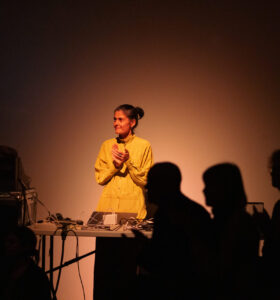
Photo Credit: Nabeeh Samaan
Kokcharova works in a wide variety of media, but one thing that ties her output together is the materials to which she tends to be drawn: the tiny and the overlooked forms of sound, whether that means the near-inaudible sounds of insects, or the never-before exploited sounds of an instrument that was designed to be in the background; or, in the case of ventilatory exploration (2019), a sound installation inspired by the San Francisco Tape Music Center, the hiss and crackle of analogue equipment noise. A second bond is an interest in the relationship of sound to place. Several works take the form of soundwalks or landscape art. intrications accidentelles (2022) pluralises the sonic reality of a space by inviting multiple walks through a given space (an agricultural area outside Geneva) to create an accidental assemblage of superimposed experiences. drifting in circles (2022) compresses a similar idea into a single walk, taking listeners on several loops around Zurich’s Old Botanical Garden, each time listening to different amplifications of the surroundings.
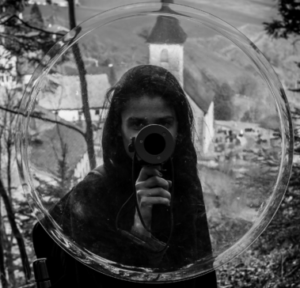
Photo Credit: Elettra-Flamigni
Kokchorova has spoken of her interest in ‘the plural points of friction between realities: where relationships between living beings, humans, ants, or plants generate noise by rubbing’. At the same time, she is not interested solely in observing the natural world: recording for her is also a performance, a compositional act: ‘I’m here with equipment’, she says, ‘and I don’t want to pretend not to be here’. Her acts of artistic auscultation, then, not only expose moments of interspecies friction, but also seek to play an active and engaged role with them.
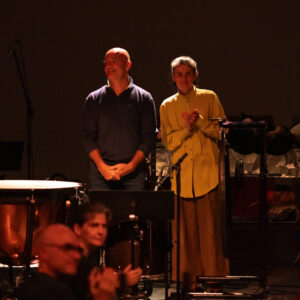
Photo Credit: Nabeeh Samaan
Recently, Kokcharova has transferred her interlocking interests in technology and the natural world to the man-made and interior world of instrumental music. Written for Switzerland’s Ensemble Contrechamps, 2022’s sculpter le voûte is a two-part work for ambisonics and ensemble that examines the sounds of wood – from the subsonic drone of sap circulation to wood’s evolving voice as it matures into a second life in the form of an instrument. At hcmf//, Contrechamps will give the UK premiere of another ensemble composition, Rapport/signal bruit, which considers how background noise and signal become blurred by the presence of human bodies, accidents and the passage of time.
Profile by Tim Rutherford-Johnson
Tickets for Ensemble Contrechamps performance of the UK Premiere of Olga Kokcharova‘s Signal-to-noise ratio and full hcmf// 2025 programme now on sale here.