
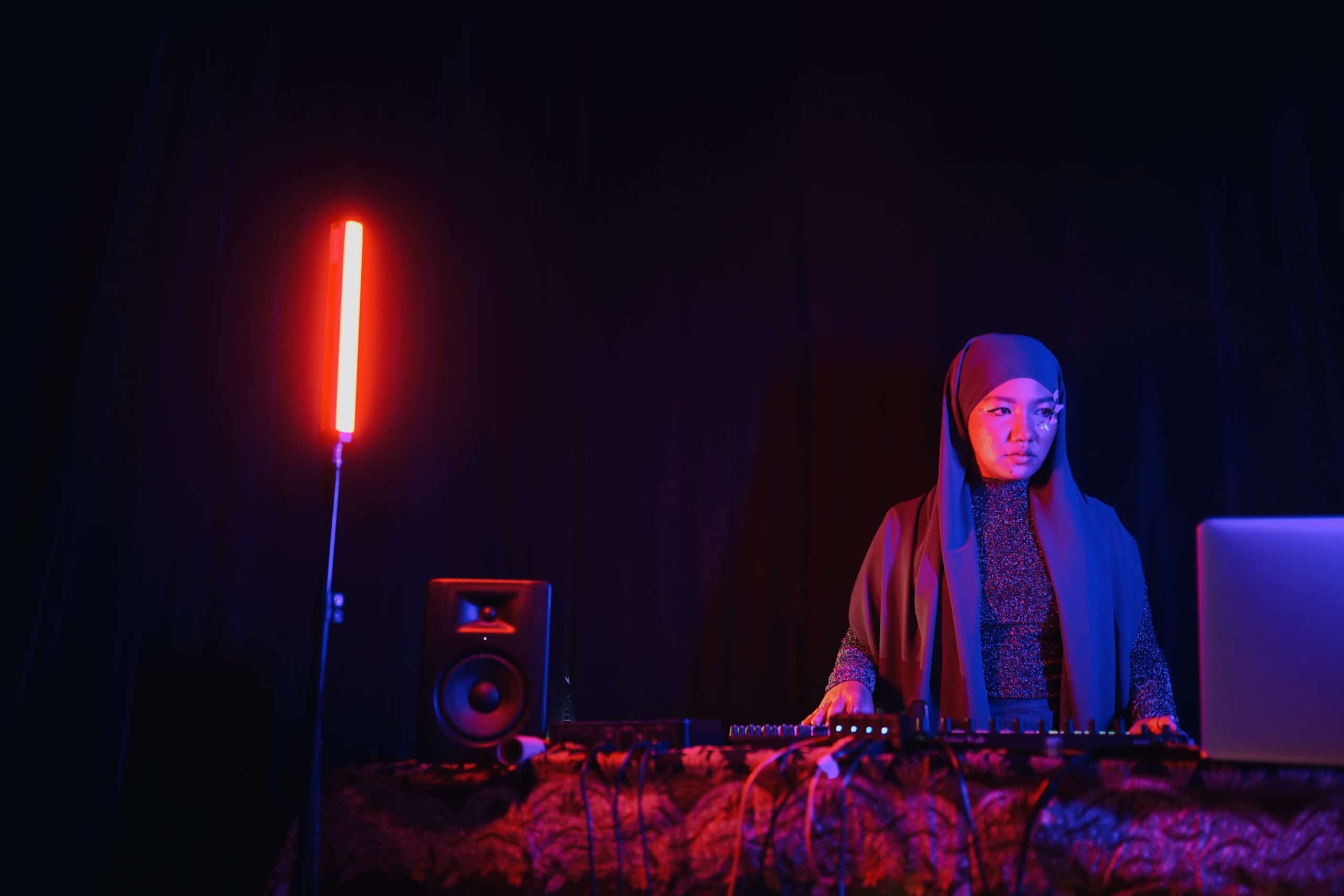
This month, we’re delighted to be hosting Rani Jambak as part of the British Council’s Musicians in Residence programme. A sound artist and ecological activist, Rani is interested in our experiences of the environment, and the ancestry found within it. Using field recordings as her base, Rani’s work is explorative and experimental, telling stories about her home city of Medan.
This residency is a change of setting for Rani. Rather than getting to know the local environment of Huddersfield in person, she’s experiencing it through a digital lens, meeting local artists online and receiving guided tours of the area from hcmf// staff. She’s hoping to forge connections between the town and her own, expanding her ecological sound campaign #FORMYNATURE into new spaces. Local landmarks and green spaces have already begun to work their way into her practice. She’s been drawn to the Huddersfield canal, and is currently developing her own water wheel, with sensors, to create a live performance with town sounds.
We’ll have more to share from Rani in the coming weeks, with first-hand accounts of the project she’s developing. To get started, we touched base with Rani to discuss the origins of #FORMYNATURE and her early experiences with Huddersfield.
You can read more about Rani’s work here.
Your ecological campaign, #FORMYNATURE, raises awareness about the climate through a series of different music pieces. Can you tell us a little bit about the project, and how it relates to your local environment?
In 2018, there was a viral news story about a dead whale found with 6 kilos of plastic in its stomach. I felt so sad and was questioning, ‘how could that have happened?’. At the same time, I was visiting a Melbourne Museum and read a story of Gunditjmara people who have been practicing sustainability and the protection of their environment. In the beginning of the story it’s written, ‘You never take more than you need’. I kept remembering this sentence and finally understood the connections between sustainable living, modern humanity, and the earth’s current situation.
The dead whale with plastic must be relatable to what humans do to this earth. I realized that humans in the past were aware of how to balance the ecosystem compared to modern people who do not even know the consequence of every single act we do to this earth, even though we are living in the fastest age of information technology. On the other side, I was thinking about human empathy towards the suffering of animals and plants, also living to fill human’s need. If we are all connected, then why do we only think about ourselves?
After this deep thinking, I started the music-ecology campaign called #FORMYNATURE. I named it with “my” to create a sense of belonging, concern, and taking care of what we have. This campaign is also related to what happened in Indonesia – the forest fires, flooding, illegal logging, wild animal hunting, etc. All the songs that I wrote for this campaign are aimed at raising awareness of this reality to others, because some people might never know about what is happening, nor any awareness of the ecological issues.
#FORMYNATURE is an ever-changing project, and with this residency, you’re continuing to explore it through a different setting. How do you imagine the project looking in a new environment?
Although this campaign has shared a different style each year, it has the same message and hope: to speak of our reality, and to offer empathy and care. This year, in my residency with hcmf//, for the first time I will make an installation of Kincia Aia (traditional water wheels from Minangkabau, West Sumatra) with sensors, creating a live performance. This is so challenging for me as I learn many new practical ways to work in building an installation and experimenting with sensors. I not only love to develop musical ideas, but also love presenting them in different ways. This work will help me expand my creativity, and also help me develop as a person.
You’re hoping to explore and connect with the green space of Huddersfield remotely through your piece. Can you tell us a little bit about your plans for this?
I want to make a connection between Minangkabau and Huddersfield through soundscapes of nature. I am so inspired by the natural landscapes of Huddersfield and Minangkabau (my ancestor land). I asked [hcmf// Learning & Participation Officer] Sophie Cooper if it was possible for me to listen to, and have some sound recordings from, Huddersfield. Sounds from both will be mixed then set to the sensors for the Kincia Aia.
You’re an artist who works primarily out in nature, with a very tactile, hands-on approach. Is this completely digital exploration of an environment a new kind of music-making experience for you?
Yes. Recording sounds in nature gives me empirical experience and a deep understanding of the human-nature connection – and how it relates to our ancestors. This connection is told through many traditional proverbs and in local wisdom. In Minangkabau, there are many proverbs telling us about the macro and micro of nature, how we should act towards the environment, and clues about spiritual energy. This magical experience brings a great gratitude in how I see myself as part of the universe.
In a creative way, these feelings bring a different sensation. The composition of nature soundscapes inspires me a lot in the next step of my productions. When I listen to each sound in one recording, I am so amazed with the richness of nature. It helps me to explore and experiment a lot.
Your sound recordings capture people, as well as environments, with city soundscapes a big part of your work. Is it important for you to emphasize our role in ecology?
Absolutely. Organically, nature grows and thrives, sustains and balances. Human nature is destructive – whatever era humans live in, they leave a great environmental damage behind them, while nature grows back to its organic shape – after a long recovery from disasters. So it is really important for humans to be aware on how important it is to take care of our environment. Because if nature is in a critical situation, so is humanity.
Field recording is also a way of connecting with history and culture for you. In your work, you record traditional instrumentation, and your project #FUTUREANCESTOR is an attempt to connect with your ancestry through sound. Can you tell us a bit about this process?
I am a Minangkabau who was born in Medan, North Sumatra. I read many sources about Minangkabau and its history to find my cultural identity. However, learning about culture only by books was not enough for me. So I decided to go to Minangkabau in West Sumatra to record sounds of nature, arts, traditional performance, instruments, socio-cultural activities, language and also interview cultural practitioners. These sound sources gave me an abstract framework for what happened in the past. Furthermore, all the sounds that I recorded could become an archive for the future. So I was thinking of preparing for the future by leaving sounds from the present to the next generation, who could then learn about their history.
This is a digital residency, but you’ve been experiencing bits of West Yorkshire first hand, attending composer meet-ups. How have you found getting to know the local music scene?
I feel so grateful to get connected with more musicians, especially in Huddersfield. This is only possible because of my virtual residency with hcmf//. Sophie Cooper has shared many events with me that I can join. This experience brings me closer to the environment of Huddersfield and helps me understand how the culture, environment and musicians connect with each other.