
The Northern Irish composer Anselm McDonnell is unafraid of contradictions. His musical upbringing was as a rock guitarist, but at the same time he was listening to ‘Bach, Beethoven, Birtwistle’ – as he names his ‘three Bs’ of classical music. It’s an eclectic beginning, but one that he has carried into his recent work. Aside from Broadway-oriented composers such as Lin-Manuel Miranda, few would attempt something like a rap opera. McDonnell, however, not only has, but with the acclaimed Politics of Imagination (2023), has also managed to pull it off.
It was while completing his PhD at Queen’s University Belfast that McDonnell became aware of his attraction to another pair of opposites – lyrical melody and noise-based textures – and began to seek ways to marry them in his music. In the solo for cello and live electronics, Three Words of Light (2021), for example, McDonnell’s music flows seamlessly from passages of extended technique to more familiar cello writing in its evocations of will-o’-the-wisps, lightning and the ‘blue hour’ period before dawn.
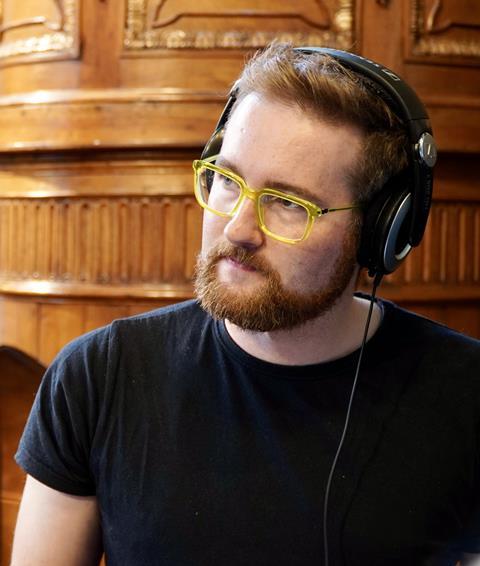
Photo: Anselm McDonnell © Cormac O’Kane
In recent years, and as his compositional range has grown, McDonnell’s interests in conflict and its resolution have been joined by a more expansive political, social and environmental outlook. Some of this comes from the complex history and culture of his native country: alongside Three Words for Light, based on phrases collected by the Irish language researcher Manchán Magan, the works on McDonnell’s debut CD, Light of Shore, examine ‘themes of faith, heritage, environment and folklore’ within a Northern Irish context; similarly, his first symphony, Guid Friday/Aoine an Chéasta (2025) commemorates the 1998 Good Friday Agreement in a blend of Irish rebel songs and Unionist marching tunes. Meanwhile, his first concerto, Hostile Summits (2025) for cellist Martin Johnson, considers mountains both as sites of vertigo and danger and as places of divine power and religious significance, while Politics of the Imagination explores the divisive politics of Brexit and the economic downturn that followed the pandemic.
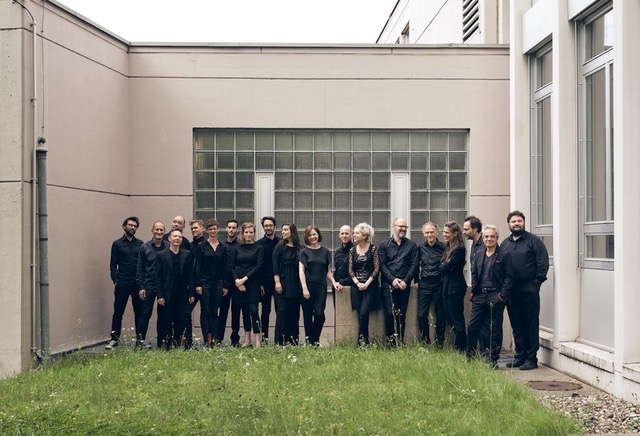
Photo: Collegium Novum Zürich © Saskja Rosset
For hcmf// this year, McDonnell has returned to landscape as a source of psychological challenge. Commissioned by the festival, his fifteen-minute Retrogressive Thaw Slump will be performed by Collegium Novum Zurich with keyboardist Dominik Blum from Steamboat Switzerland (who last appeared in Huddersfield twenty-one years ago) on the organ of the Town Hall. Its title refers to a geological formation found in the permafrost areas of the northern hemisphere now under the conditions of climate change: landslides and collapses that occur when water formerly locked in the ground as ice melts, compromising its structure and stability. The world’s largest such slump is the Batagaika Crater, an arrow-shaped gorge in eastern Siberia one kilometre long and more than 100 metres deep. It began to form in the 1960s after deforestation upset the local geology, and it continues to widen by twenty to thirty metres a year. ‘The crater will likely eat through the entire hillslope before it slows down’, says Professor Mary Edwards of Southampton University. ‘Once you’ve exposed something like this, it’s very hard to stop it’. A devastating symbol of mankind’s impact on the environment in even the most remote parts of the world, Batagaika is also a treasure trove for palaeontologists and climate scientists, the slump exposing in its sheer rock walls two hundred thousand years of pristine natural history. In McDonnell’s response, we can expect such contrasts and complexity to be explored with striking immediacy and emotional power.
Profile by Tim Rutherford-Johnson
Tickets for Collegium Novum Zürich’s performance of the UK Premiere of Anselm McDonnell’s Retrogressive Thaw Slump (2026) are now on sale here.