
Away from his work as a composer, Nicholas Moroz performs and curates in his role as director of Explore Ensemble. The UK-based music group have been a mainstay of hcmf// in recent years, bringing innovative and inventive programming with them. In this post, Moroz guides us through his work with Explore, giving us insight into their wider aims as a group.
The evolution of the Explore Ensemble over the years reflects our players, my programming, and our changing interests as a group and as individuals. We started as a looser collective of players and composers at RCM in 2012, put together by Arne Gieshoff and me. After a solid group of brilliant players formed for our second concert we thought it would be fun to work more like a fixed ensemble and explore a wider mix of music that we wanted to hear, and which the players found rewarding to prepare and perform (often because of its virtuosity). Since then we have usually worked as a sextet (flute, clarinet, piano, string trio) or combinations thereof, often with electronics, and occasionally as a larger group with guest players and conductors.
Early Days
In the early years, and still to this day, a fair amount of our work has focused on late modernist music (from the 1980s onwards). Starting out, there was an emphasis on spectral and post-spectral composers like Grisey, Murail, Romitelli, and Saariaho, as well as others like Aperghis, Feldman, Saunders, and Sciarrino. At the time we felt that besides string quartets like Arditti or JACK, you’d rarely get to hear excellent chamber concerts of this kind of music in London with dedicated groups that weren’t just scaled-down orchestras or larger ensembles. This looked like a good niche for us to explore.
One of the highlights from our student days was Fausto Romitelli’s trilogy Professor Bad Trip in 2014, which was the first performance of the complete cycle in London. I can’t forget playing the bass guitar part alongside everyone else under dark lights after we covered ourselves in multicoloured UV paint!
Building a Community
Over the years the group has developed a really strong chemistry and its own micro-culture for rehearsing and performing. I like to think that it’s this combo of formidable musicians and their interpersonal chemistry that stands Explore Ensemble out, besides anything I might be trying to do with programming. We value being able to communicate directly to the audience, without the physical barrier or the implied social-hierarchy of a conductor, we’re all friends, after all.
For everything that we do we always go for quality over quantity. When it comes to how I programme, rather than have us churn through composers (we don’t do calls for scores or dodgy competitions) or chase whatever seems fashionable, I’ve instead tried to use our scarce resources to develop deeper and longer-lasting relationships with composers whom we as a group all believe in. In commissioning new work it’s been a privilege to get to know people like Joanna Bailie, John Croft, Lisa Illean, Oliver Leith, and James Weeks – and their music (and many other people too!).
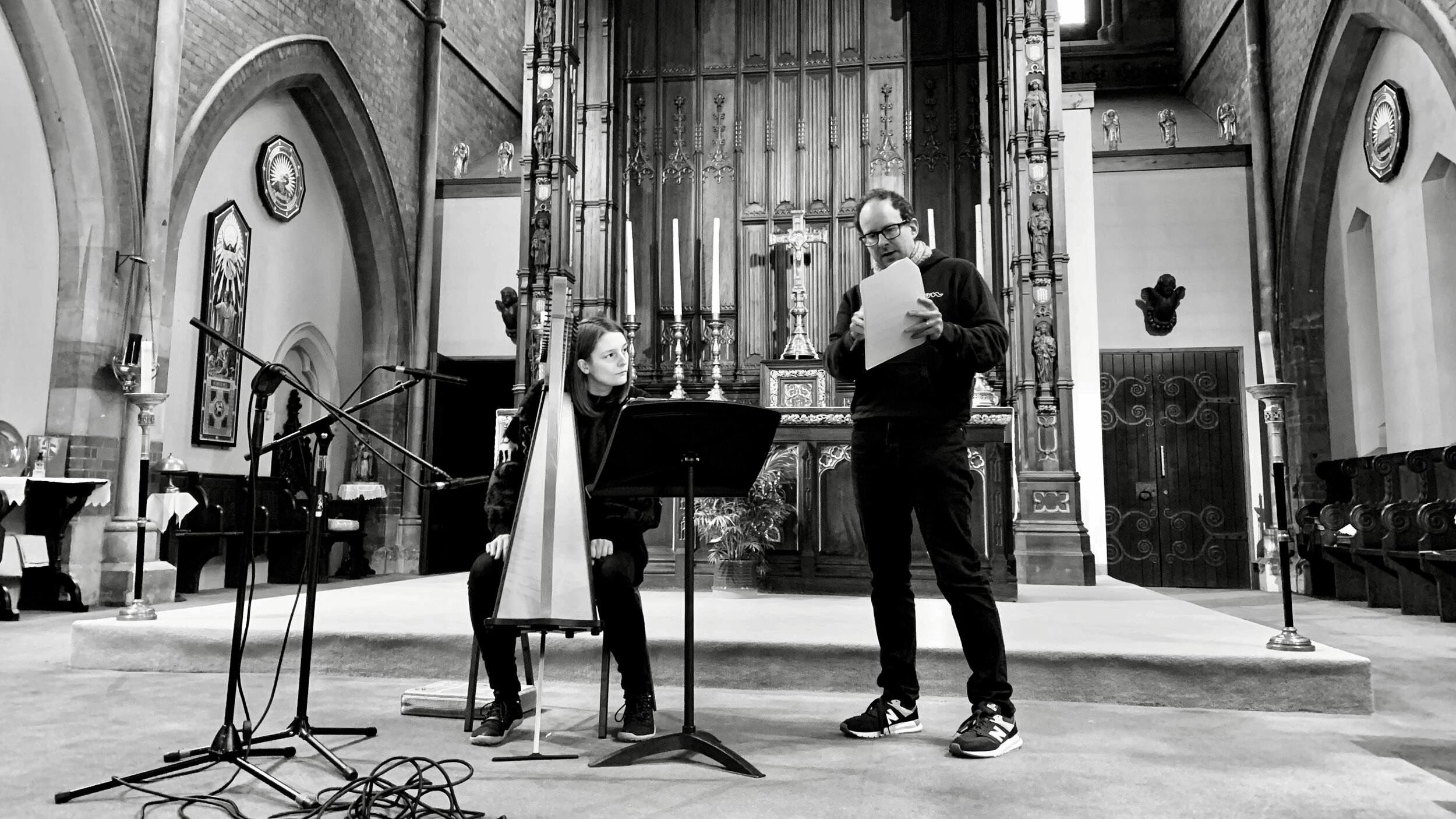
Building a sense of community and trust, in whatever small way we can manage, is also important here. Sadly I find a lot of cynicism in new music, actually more among established musicians and admin types rather than audiences. I feel that as a younger group of millennials, it’s our duty to try to open up new musical possibilities, new ways to connect and relate with audiences, while also leaving behind some of the hangups of the older generations behind.
Looking beyond the modest scale of the ensemble there are several problems in the wider UK classical music field which preoccupy me right now, but which I don’t have simple answers for. It’s a discussion for another time, but in a nutshell, I see classism as the fundamental yet critically under-discussed factor that threatens greater accessibility, equality, diversity, and sustainability in the UK (not only in music, of course). All the recent gains with representation in the arts will be meaningless, in my view, if everyone playing and listening comes from an ever-exclusive pool of private school kids, where classical music is just another luxury commodity or fancy sport. We need reform of education and arts support if we’re to build a fairer culture, but I’m not optimistic right now.
That all said, I see people and things out there which offer a brighter vision, places like hcmf//, Counterflows and Tectonics in Glasgow, LCMF and Cafe OTO in London. I admire and look up to these organisations in how they engage local and international communities, which combine grassroots and professional artists, and cover a range of styles and genres without losing their own clear identity or aesthetic. In a way, because of their drive, visions, and progressive outlook, I think new and experimental music people and organisations are better suited to tackle the problems created upstream by the norm-core classical music institutions (conservatoires, orchestras, media, funders, patrons) than those institutions themselves, even though they have, on the whole, much less power.
hcmf// and Beyond
Looking back, hcmf// has played a huge role in catalysing the ensemble’s growth since our first appearance in 2016 in one of the Shorts concerts. We performed Grisey’s Talea, one of our go-to pieces. Our first outing in Huddersfield was memorable not only for the warm response from the audience who filled out the Town Hall, but also for the freezing cold storm that drenched and battered us as we ran up and down the hills across town while trying to catch the other Shorts events! We now look forward to the storms whenever we go.
Graham McKenzie invited us back for the 2017 edition, and we gave a concert including music by Enno Poppe, Fausto Romitelli, Steven Daverson, and a premiere co-commissioned with the festival by Patricia Alessandrini. Patricia’s piece included her new augmented piano and live electronics tech which she had developed at Goldsmiths. Her piece, Tracer la lune d’un doigt, conjures a hauntingly beautiful shadow-world, etched from warped transcriptions of Bach.
As that concert showed, working with electronics is important for us, especially for me as a composer too. As a smaller group, technology allows us to expand our capabilities, but it also suggests new ways of working and performing. After Patricia Alessandrini’s piece at hcmf//, another stand out performance for me was the Principal Sound festival at St John’s Smith Square in 2018, curated by Sam Wigglesworth, when we opened it with Luigi Nono’s A Pierre. Dell’azzurro Silenzio Inquietum. I’ll never forget the mixture of nerves and excitement as we played in pitch-black, with bass flute and contrabass clarinet up high on opposing galleries and the otherworldly electronics hovering around that huge space.
2018 also saw us debut at Kings Place as part of their Time Unwrapped series, when we performed another monumental piece by Grisey: Vortex Temporum. Another highlight of that concert was our new piece with Lisa Illean, for sextet and audio: Weather a Rare Blue.
We returned to hcmf// that year too for a very special project, combining forces with our musical heroes from the Exuadi Vocal Ensemble, conducted by James Weeks. Together we gave the UK premiere of Salvatore Sciarrino’s song-cycle, Carnaval. It was an honour to work alongside Exaudi on such a substantial musical statement. Hopefully it won’t be too long before we work on something together again.
Our next feature at hcmf// was in 2020 when we gave the opening live radio concert on BBC Radio 3’s New Music Show. It came like an oasis in the desert of the pandemic. We hadn’t given a public concert for 9 months, and many of us hadn’t seen one another over lockdown. In the context of all the darkness of that time, especially over the winter, that concert as a real privilege; working together again in a real space, presenting new pieces that had had all their performances postponed, having a platform to connect with audiences. I don’t take for granted that so many other musicians were silent, anxious, and alone at that time.
We opened with Lawrence Dunn’s Sentimental Drifting Music, which is a beautiful piece, like an undulating tapestry of hushed and hazy microtonal polyphonies.
Second was Joanna Bailie’s video piece, Dissolve, co-commissioned with hcmf// and November Music, which missed its video component for the radio performance. I’m extremely excited about our plans later this year at several festivals to give the full performance – it’s an utterly stunning and mesmeric piece, wandering through the streets of Berlin and getting lost in the blurry lights. Although Joanna made the film before the pandemic, I think the video takes on new meanings after most of us have spent the last year on so many local walks in lockdown.
Finally there was Oliver Leith’s Me Hollywood, for sextet and tv, and co-commissioned with hcmf// and November Music. I had long been anticipating this from Oliver, and when it came it took me by surprise (pleasantly!). The piece is like a little drama. Oliver imagines the ensemble as a hired band, soundtracking the everyday domesticity of their patron’s life as they bum around home, having a drink, watching TV, checking voicemails, taking a shower, tending to their guinea pigs. Someone described it as like a willing Truman Show.
This leads me to two of our most recent projects – our first record releases, and perhaps to make up for lost time, we made two! Last month saw the release of two portrait albums of Oliver Leith and James Weeks on the Another Timbre label, entitled Me Hollywood and Summer respectively. Recorded over lockdown, these discs each bring together threads that have been converging for years, and which hcmf// has has a hand in spinning too.